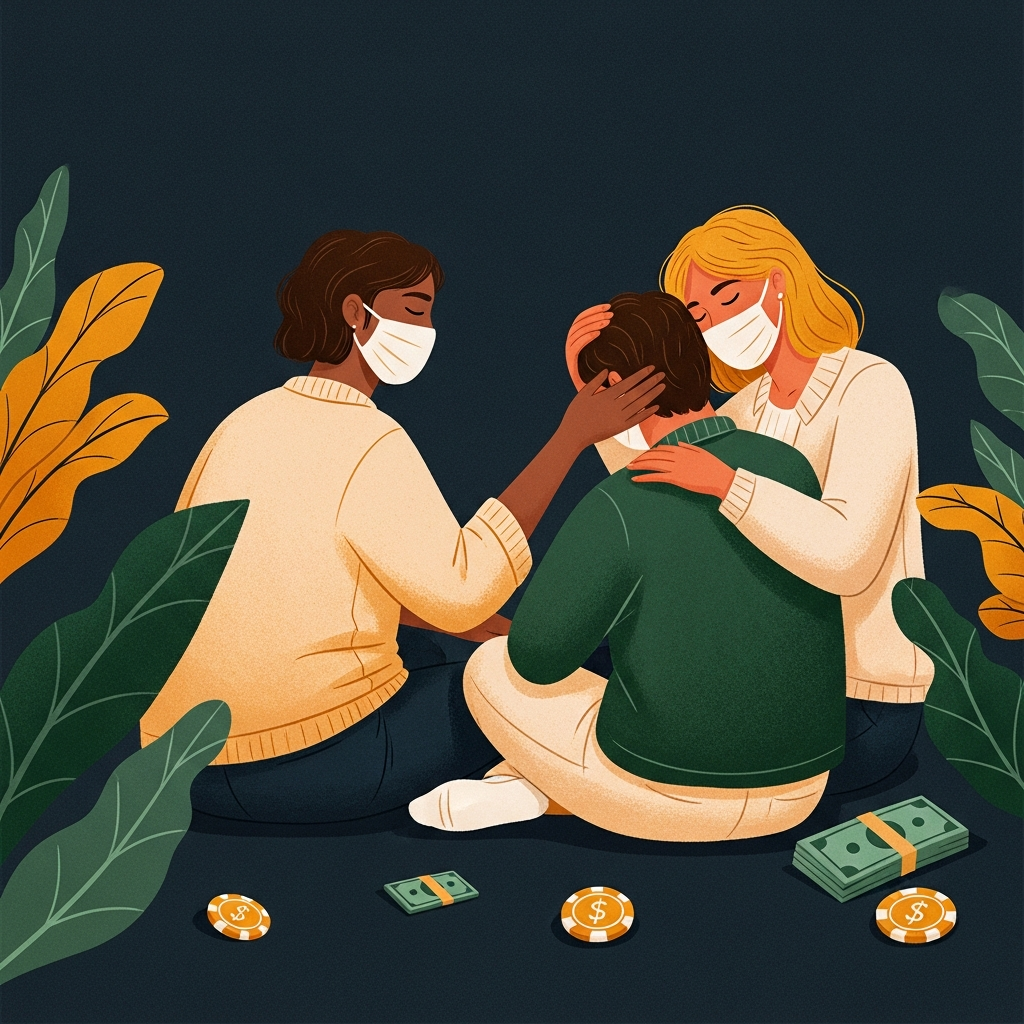
If your spouse has a gambling problem, you need your own recovery too. Learn how to set boundaries, recognize codependency patterns, and find support through Gam-Anon.
You didn't cause it. You can't control it. You can't cure it.
If your spouse or partner is struggling with gambling addiction, you've probably already tried everything — monitoring bank accounts, hiding credit cards, giving ultimatums, crying, screaming, bargaining. None of it worked. That's not because you failed. It's because gambling addiction is a progressive illness that cannot be controlled by someone else's willpower.
The phrase above comes from Gam-Anon, the 12-step program for family members of compulsive gamblers. It's deceptively simple. It takes most people months or years to truly accept it.
The supporter's hidden crisis
Research from the National Council on Problem Gambling estimates that for every person with a gambling problem, 6-8 family members are directly affected. Spouses bear a disproportionate burden:
- Financial devastation — hidden debts, drained savings, mortgaged homes, destroyed credit
- Emotional betrayal — lying about money is experienced as deeply as infidelity
- Hypervigilance — constantly checking bank statements, phone logs, whereabouts
- Isolation — shame prevents most spouses from telling anyone what's happening
- Health impacts — chronic stress, anxiety, depression, insomnia, and physical illness
A study published in the Journal of Gambling Studies found that partners of compulsive gamblers show rates of anxiety and depression comparable to those of the gamblers themselves.
Recognizing your supporter pattern
Most spouses of compulsive gamblers develop one of five common patterns:
The Rescuer
You try to fix everything — covering debts, making excuses, managing consequences. You believe if you just love them enough, protect them enough, they'll stop.
The Controller
You monitor every transaction, check every receipt, demand accountability at every turn. Financial surveillance becomes a full-time job.
The Denier
You minimize the severity. "It's not that bad." "They only gamble on weekends." "At least they're not drinking." Denial protects you from the magnitude of the problem.
The Martyr
You sacrifice everything — your happiness, your health, your needs — for the sake of your partner's recovery or your children's stability.
The Partner
This is where healthy recovery leads. You maintain boundaries, take care of yourself, support without enabling, and recognize that your recovery is separate from theirs.
How to set healthy boundaries
Boundaries are not punishments. They're the conditions under which you can remain healthy while loving someone who is sick.
Financial boundaries
- Open separate bank accounts
- Remove your name from joint credit cards
- Do not pay gambling debts
- Secure your own financial future regardless of their choices
- Consider consulting a financial advisor who understands gambling-related debt
Emotional boundaries
- You are not responsible for their feelings about your boundaries
- You can love someone and refuse to participate in their illness
- "No" is a complete sentence
- You don't need to explain, justify, or defend your boundaries
Practical boundaries
- Don't lie for them — to employers, family, or friends
- Don't track their location obsessively (this harms you more than it helps them)
- Don't search for evidence of gambling — you already know
- Do maintain your own social connections and support system
Finding your own recovery
Your spouse needs GA. You need Gam-Anon.
Gam-Anon is a 12-step fellowship specifically for the family members and friends of compulsive gamblers. In Gam-Anon, you'll find people who understand — who've lived through the same financial devastation, the same lies, the same impossible love.
What happens at a Gam-Anon meeting
- You listen to others share their experience
- You're not required to speak
- Everything shared is confidential
- There are no dues or fees
- You learn that you're not alone — and that recovery is possible for you too
Find a Gam-Anon meeting: gam-anon.org
What not to do
- Don't give ultimatums you won't follow through on — empty threats erode trust and your own self-respect
- Don't take over their recovery — attending meetings for them, calling their sponsor, managing their step work
- Don't neglect your own mental health — therapy, self-care, and your own support network are not selfish
- Don't make their addiction the center of your entire life — you had an identity before this
When to seek professional help
Consider individual therapy or couples counseling (with a therapist experienced in addiction) if you're experiencing:
- Persistent anxiety or depression
- Difficulty sleeping or eating
- Inability to trust anyone
- Thoughts of self-harm
- Complete loss of your own identity outside the relationship
Frequently asked questions
Should I stay or leave?
This is the most common question spouses ask, and there's no universal answer. What matters is that you make the decision from a place of strength and clarity — not from desperation, guilt, or fear. Gam-Anon can help you find that clarity.
Will they ever stop?
Many compulsive gamblers do achieve sustained recovery through Gamblers Anonymous and professional support. But their recovery is not within your control, and waiting for them to change is not a recovery plan for you.
How do I protect my children?
Children are affected by gambling addiction even when parents try to shield them. Age-appropriate honesty, emotional stability from at least one parent, and family therapy can make a significant difference. Your recovery gives your children a model of health.
What if they refuse to get help?
You cannot force someone into recovery. What you can do is take care of yourself, set boundaries, and make it clear what you will and won't accept. Sometimes the most loving thing is to stop making their addiction comfortable.
recovery doesn't happen alone.
Join the waitlist for 12&Well — 24/7 AI support, geo protection, recovery music, and tools for the whole family.
Join the Waitlist