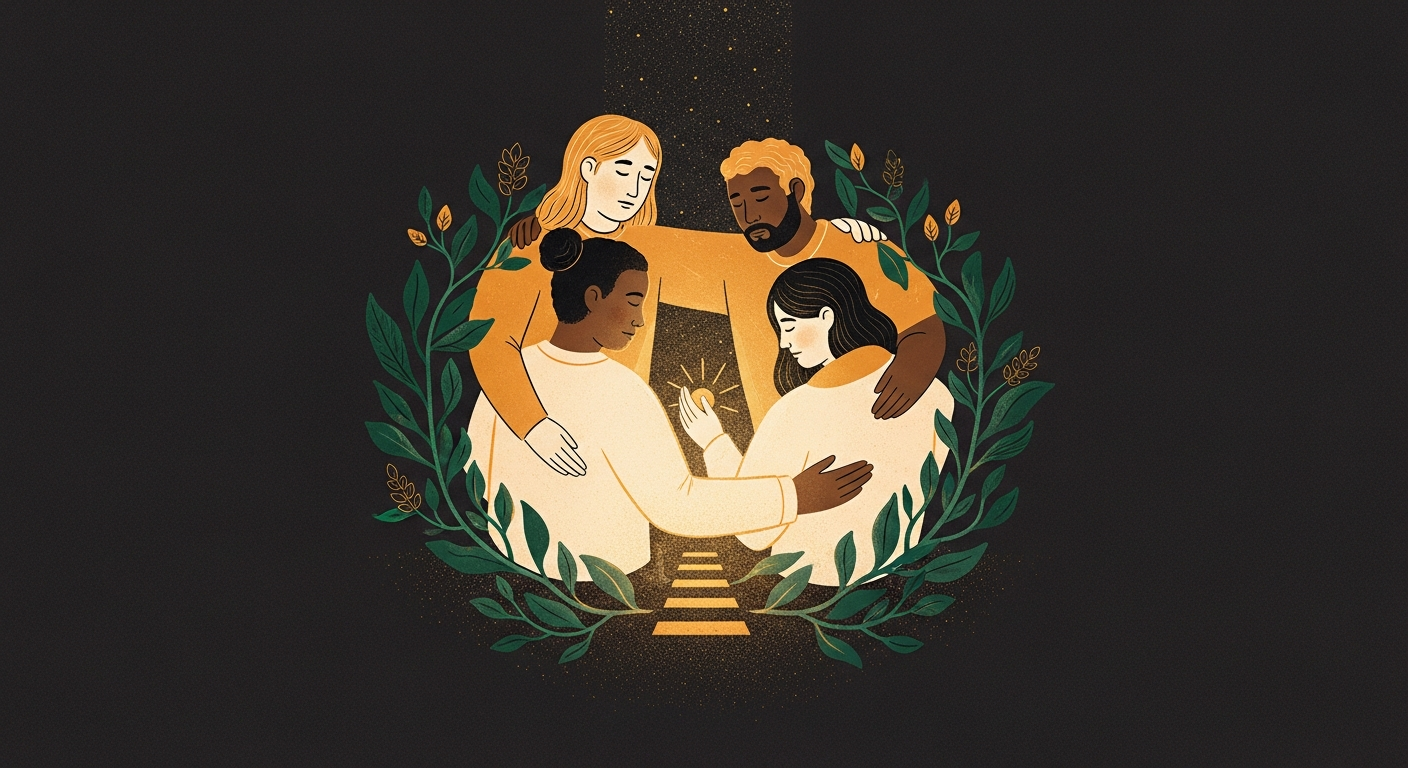
Step 1 of Gamblers Anonymous asks you to admit powerlessness over gambling. Learn what it means, how to work it, and why it's the foundation of recovery.
"Tonight we kill your reputation" — La Confesion, 12&Well
Step 1 of Gamblers Anonymous is the foundation of the entire 12-step recovery journey. It asks you to admit that you are powerless over gambling — that your life has become unmanageable. This isn't about weakness. It's about honesty. And for many people, it's the single hardest and most liberating thing they'll ever do in recovery.
That might sound contradictory. How can admitting powerlessness set you free?
If you've been carrying the weight of compulsive gambling — the lies, the debt, the isolation, the constant mental chess of covering your tracks — then you already know the exhaustion. You've been managing an unmanageable life for a long time. Step 1 is the moment you stop pretending you have it under control.
It's the moment you put the weight down.
What Step 1 Actually Says
The exact language of GA's Step 1 reads: "We admitted we were powerless over gambling — that our lives had become unmanageable."
Two parts. Both matter.
Powerlessness means you've lost the ability to control your gambling through willpower alone. You've tried cutting back. You've tried setting limits. You've tried switching from one type of gambling to another. And every time, you ended up back in the same place — or somewhere worse.
Unmanageability means the consequences have bled into every corner of your life. Finances. Relationships. Work. Sleep. Mental health. Your sense of who you are. When the GA program talks about unmanageability, it's not asking whether you've hit some dramatic low point. It's asking whether gambling has made your life harder to live honestly.
You don't need to lose everything to qualify. You just need to be honest about what you've already lost.
Why Powerlessness Is Not Weakness
This is where most people get stuck — and it's worth spending time here, because the misunderstanding keeps people suffering longer than they need to.
Our culture tells us that willpower is the answer. That if you just try harder, want it more, or discipline yourself enough, you can beat any problem. And for some challenges, that works. But compulsive gambling rewires the brain's reward system in ways that make willpower unreliable at best and dangerous at worst.
Research from the American Psychological Association has shown that gambling activates the brain's dopamine pathways in patterns nearly identical to substance use disorders (APA, 2017). The National Council on Problem Gambling estimates that approximately 2 million U.S. adults meet the criteria for severe gambling problems, with another 4–6 million considered moderate (NCPG, 2023). These aren't people who lack character. They're people whose brains have been hijacked by a compulsion that operates below the level of conscious choice.
When Step 1 asks you to admit powerlessness, it's not saying you're a weak person. It's saying you've been fighting the wrong battle. You've been trying to control something that, by its nature, you cannot control through force of will. And the moment you stop fighting that losing war is the moment you can start building something new.
That's what the song La Confesion gets at — the idea that sometimes the thing you've been protecting most fiercely, your reputation, the image of having it together, is the very thing keeping you trapped. Killing the lie is the first step toward living the truth.
What Unmanageability Looks Like in Real Life
Unmanageability doesn't always look dramatic from the outside. Sometimes it's quiet. Sometimes only you know.
Here are some of the ways it shows up:
- Financial chaos — Hidden debt, maxed credit cards, borrowed money you can't repay, bills going unpaid, retirement accounts drained
- Relationship damage — Lying to your partner, canceling plans to gamble, emotional withdrawal, broken promises you meant to keep
- Work and responsibilities slipping — Missing deadlines, calling in sick, inability to concentrate, gambling during work hours
- Mental health decline — Anxiety, depression, insomnia, suicidal thoughts. According to SAMHSA, people with gambling disorders are significantly more likely to experience co-occurring mental health conditions, including a suicide attempt rate that is notably higher than the general population (SAMHSA, 2022)
- Isolation — Pulling away from friends and family, feeling like no one understands, living a double life
You might look at this list and think, that's not me — not all of it. And maybe not. But if even two or three of these resonate, that's unmanageability. You don't have to check every box.
How to Work Step 1
Step 1 isn't something you do once and move on from. It's something you return to — especially in early recovery, especially when the compulsion tries to convince you that this time will be different.
Here's how people in the rooms typically approach it:
Get Honest With Yourself
Before you talk to anyone else, sit with the truth. Write down what gambling has cost you — not just money, but time, relationships, trust, peace of mind. This isn't an exercise in shame. It's an exercise in clarity.
Some people in GA write what's called a "Step 1 inventory" — a personal accounting of the unmanageability in their lives. If writing feels too heavy to start alone, that's okay. Tools like Hope AI on 12&Well can help you process your thoughts at your own pace, 24/7, without judgment. Sometimes it's easier to be honest with a screen before you're honest with a room.
Share It With Someone
Recovery doesn't happen in isolation. At some point, the truth needs to leave your head and enter the world. In GA, this often happens in a meeting — when you stand up and say some version of, "My name is _____, and I'm a compulsive gambler."
But it doesn't have to start there. It can start with a phone call to the National Problem Gambling Helpline at 1-800-522-4700 — available 24/7, confidential, and free. It can start with telling one trusted person. It can start in a digital community where you don't have to show your face.
The point is connection. The lie thrives in secrecy. The truth needs a witness.
Accept That You Can't Do This Alone
This is the part that feels counterintuitive if you've spent your whole life solving problems by yourself. Step 1 is an invitation to stop relying solely on yourself — because the self you've been relying on is the same self that keeps gambling.
This doesn't mean you're broken. It means you need support. That support might come from GA meetings, a sponsor, a therapist who specializes in gambling disorders, SMART Recovery, a faith community, an online program, or a combination of tools that works for you.
12&Well was built around this idea — that recovery isn't one-size-fits-all, and that people need different tools at different moments. Some days you need a meeting. Some days you need a guided urge timer at 2 a.m. Some days you need to hear a song that makes you feel less alone. All of it counts.
Step 1 for Supporters and Family
If you're reading this as a spouse, partner, parent, or friend of someone who gambles compulsively, Step 1 applies to you too — just differently.
Gam-Anon, the fellowship for people affected by someone else's gambling, has its own version of Step 1. It asks supporters to admit that they are powerless over the gambler — not over gambling itself, but over the person doing it. You cannot control their choices. You cannot love them into recovery. You cannot manage their unmanageability for them.
This is painful. Especially if you've been the one holding everything together — paying the bills they can't pay, making excuses, absorbing the chaos so the kids don't see it.
But your own recovery starts the same way theirs does: with honesty. The Am I Enabling? assessment tool on 12&Well is a free, private way to start examining the patterns in your own life. No signup required. Just honest questions and personalized results.
Approximately 1.6 million children in the United States are affected by a parent's gambling problem (NCPG, 2023). If you're supporting someone in recovery, you're not just helping them — you're protecting the people around them. You deserve your own support.
What Comes After Step 1
Step 1 is the beginning, not the whole journey. It opens the door to Step 2 — coming to believe that a power greater than yourself can restore you to a normal way of thinking and living. But we'll get there.
For now, the work is simpler and harder than anything that follows: tell the truth. About what gambling has done to your life. About the fact that you can't control it. About the reality that something needs to change.
You don't have to know what recovery looks like yet. You don't have to commit to any particular program or path. You just have to be willing to stop pretending.
If you're not ready for a meeting, start with a free tool. The Financial Impact Calculator can help you face the numbers. The Urge Surfing Tool can help you ride out the next craving. Hope AI is there at any hour you need to talk.
And if you are ready for a meeting, the GA Meeting Finder can help you find one near you — tonight, if that's what you need.
Recovery starts when the truth gets louder than the compulsion. Step 1 is how you turn up the volume.
Frequently Asked Questions
What is Step 1 of Gamblers Anonymous?
Step 1 of GA asks you to admit that you are powerless over gambling and that your life has become unmanageable. It's the foundation of the 12-step recovery process — an honest acknowledgment that you cannot control your gambling on your own and that it has caused real harm in your life.
Does admitting powerlessness mean I'm weak?
No. Admitting powerlessness is one of the most courageous things you can do. Neuroscience research shows that compulsive gambling changes the brain's reward pathways in ways that make willpower alone insufficient (APA, 2017). Step 1 isn't about weakness — it's about recognizing the nature of what you're facing and opening the door to a different approach.
Do I have to go to a GA meeting to work Step 1?
GA meetings are a powerful place to work Step 1, but they're not the only path. Some people start with a therapist, a helpline call (1-800-522-4700), SMART Recovery, or digital tools like 12&Well's Hope AI. What matters most is honesty — wherever and however you practice it.
How does Step 1 apply to family members of someone who gambles?
Gam-Anon's Step 1 asks supporters to admit they are powerless over the gambler. You can't control someone else's addiction, no matter how much you love them. Your own recovery begins with accepting this and seeking support for yourself — through Gam-Anon, therapy, or resources like 12&Well's supporter community and assessment tools.
This content is for informational purposes only and is not a substitute for professional medical advice, diagnosis, or treatment. If you or someone you love is struggling with compulsive gambling, call the National Problem Gambling Helpline at 1-800-522-4700 — free, confidential, and available 24/7.
12&Well Editorial Team — Written by people in recovery, for people in recovery. Our team includes GA members, Gam-Anon members, and recovery advocates. We never accept funding from the gambling industry. If you need help right now, call 1-800-522-4700 (24/7).
recovery doesn't happen alone.
Join the waitlist for 12&Well — 24/7 AI support, geo protection, recovery music, and tools for the whole family.
Join the Waitlist