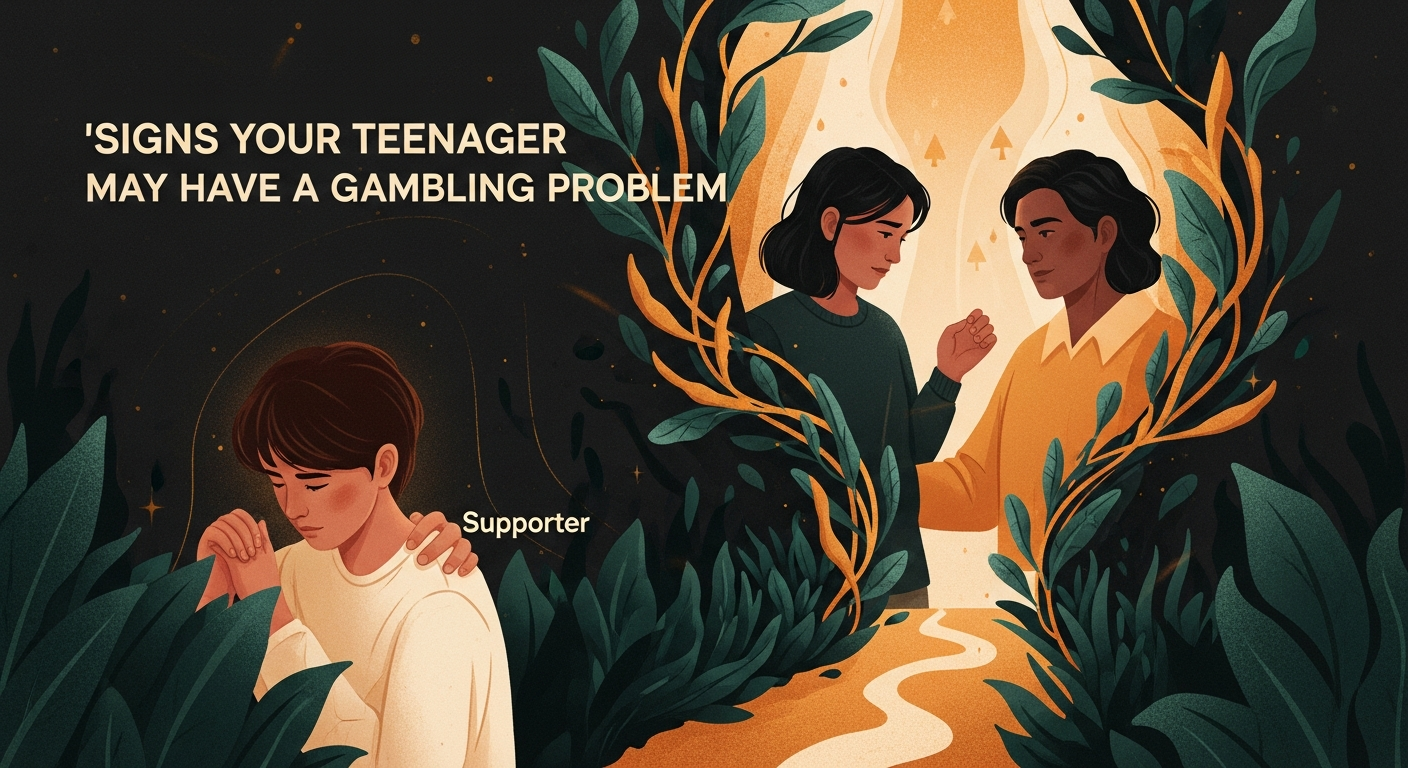
Spot the warning signs of teen gambling problems early. A parent's guide to red flags, conversation starters, and real next steps for help.
"Where did I go wrong?" That's the question echoing in your mind at 2 a.m. — and it's the wrong one. The right question is: "What can I do now?"
A teen gambling problem shows up as sudden secrecy around money, unexplained mood swings tied to sports events or online activity, withdrawal from friends and family, and a growing obsession with betting apps or gambling content. If your teenager is showing these signs, you're not overreacting — and you're not alone. Roughly 60–80% of adolescents report having gambled in the past year, and between 4–8% of teens meet criteria for a serious gambling problem (National Council on Problem Gambling).
This isn't a phase. It isn't "just something kids do." And catching it early can change the entire trajectory of your child's life.
Why Teen Gambling Is Different Than You Think
When most parents picture compulsive gambling, they imagine a casino floor. Slot machines. Poker tables. Adults.
That picture is decades out of date.
Today's teen gambling lives on phones. It hides inside apps that look like games. It thrives in group chats where friends share parlays and "guaranteed picks." It's normalized by a culture that treats betting as entertainment — not as what it actually is for some kids: the beginning of an addiction.
Here's what makes teen gambling uniquely dangerous:
- The adolescent brain isn't finished developing. The prefrontal cortex — the part responsible for impulse control and risk assessment — doesn't fully mature until the mid-20s (American Psychological Association). This means teens are neurologically more vulnerable to the dopamine cycle that drives compulsive gambling.
- Access has exploded. An estimated 45% of teens have gambled online at least once, often on unregulated or social gaming platforms that blur the line between gaming and gambling (International Centre for Youth Gambling Problems and High-Risk Behaviors, McGill University).
- Social pressure amplifies everything. Sports betting ads saturate social media feeds. Friends talk about wins — never losses. The culture tells your kid that gambling is normal, fun, and harmless.
You're not fighting a single bad decision. You're up against an entire ecosystem designed to make gambling feel inevitable.
The Warning Signs — What to Actually Look For
Some of these signs will look like "normal" teen behavior. That's what makes this hard. But when multiple signs cluster together — or when the intensity escalates — trust your instincts. You know your child.
Financial Red Flags
- Money disappearing without explanation. Allowance gone the same day they get it. Cash missing from your wallet or a sibling's room. Unexplained charges on a debit card or prepaid card.
- Sudden interest in borrowing money — from you, from friends, from relatives. Especially when the reasons feel vague or shift each time you ask.
- Selling personal belongings. Clothes, electronics, gifts — anything that converts to cash quickly.
- Hidden financial apps. Look for peer-to-peer payment apps (Venmo, Cash App, Zelle) with unusual transaction patterns, or cryptocurrency wallets they can't explain.
Behavioral Changes
- Secrecy around their phone. Turning the screen away from you. New passwords. Deleting apps or browser history frequently.
- Sleep disruption. Staying up late — sometimes to watch live sporting events in different time zones, sometimes because the anxiety of losses won't let them rest.
- Withdrawal from activities they used to love. Quitting sports, skipping time with friends, dropping hobbies. When gambling becomes the primary dopamine source, everything else starts to feel flat.
- Mood swings tied to external events. If your teen's emotional state seems to rise and crash in patterns you can't explain — especially around weekends or sporting seasons — gambling may be the hidden variable.
Emotional and Social Shifts
- Increased irritability or defensiveness when you ask about money, their phone, or where they've been.
- Lying. Not small, age-appropriate stretches of the truth — but layered, repeated lies that feel practiced.
- New friend groups that seem centered around activities your teen won't discuss openly.
- Expressions of hopelessness or despair that feel disproportionate. Teens in gambling trouble often carry shame they can't articulate. Research shows that adolescents with gambling problems are significantly more likely to experience depression, anxiety, and suicidal ideation (Derevensky & Gupta, 2004, Gambling Problems in Youth).
That last point matters more than any of the others. If your teenager is expressing hopelessness — even casually — take it seriously. Call the National Problem Gambling Helpline at 1-800-522-4700. It's free, confidential, and available 24/7.
What Drives a Teenager Into Compulsive Gambling
Understanding the "why" doesn't excuse the behavior — but it helps you respond with clarity instead of panic.
The Dopamine Factor
Gambling triggers massive dopamine surges in the brain. For a teenager whose reward system is still developing, those surges are more intense — and more habit-forming — than they are for adults. The near-miss effect (almost winning) activates the same neural pathways as an actual win, creating a feedback loop that's incredibly hard to break without support (Clark et al., Neuroimaging of Gambling, 2013).
Your teen isn't weak. Their brain is being hijacked by a system designed to exploit exactly this vulnerability.
Social Normalization
The gambling industry spent an estimated $1.8 billion on advertising in 2023 alone (American Gaming Association). Much of that spend targets young men through sports media, influencer partnerships, and social platforms. When every podcast, every halftime show, and every friend group normalizes betting, your teenager isn't making a free choice — they're swimming in a current.
Escape and Coping
Some teens gamble to escape anxiety, depression, academic pressure, or family stress. The action provides temporary relief — a few minutes or hours where the only thing that matters is the next outcome. If your teen is using gambling to cope, the gambling is a symptom. The underlying pain needs attention too.
How to Start the Conversation
This is the part that terrifies most parents. You're afraid of pushing them further away. You're afraid of saying the wrong thing.
Here's the truth: an imperfect conversation is infinitely better than silence.
What Works
- Lead with love, not accusation. "I've noticed some things that worry me, and I want to understand what's going on" opens a door. "I know you've been gambling" slams it shut.
- Be specific about what you've observed. Not "you're always on your phone" — but "I noticed money missing from your account three times this month, and you've been staying up past 2 a.m. on weekends."
- Listen more than you talk. Your instinct will be to lecture. Resist it. Let them talk. The more they share, the clearer the picture gets.
- Acknowledge that this is hard for them. Shame is the engine of addiction. If your teen feels judged, they'll shut down. If they feel seen, they might crack the door open.
- Don't demand an immediate solution. This isn't a one-conversation fix. You're starting a process.
What Doesn't Work
- Ultimatums without support. "Stop gambling or else" doesn't work for the same reason "just stop" never works with any addiction — it treats the behavior without addressing what's driving it.
- Shaming. "How could you be so stupid?" may feel cathartic in the moment. It will cost you months of trust.
- Taking over their finances entirely without explanation. Control without collaboration breeds resentment and drives the behavior further underground.
What to Do Next — Real Steps, Not Just Advice
For Your Teen
- The National Problem Gambling Helpline (1-800-522-4700) offers resources specifically for youth. They can call or text — and so can you.
- Gamblers Anonymous has meetings in most areas, including some specifically for younger people. The 12-step framework gives teens structure, accountability, and a community that understands. Find meetings at gamblersanonymous.org.
- Therapy matters. Cognitive behavioral therapy (CBT) has the strongest evidence base for adolescent gambling problems (Gooding & Tarrier, 2009). A therapist who specializes in behavioral addictions can make a significant difference.
- 12&Well's free tools are built for exactly this moment. The Browser Shield blocks over 264,000 gambling domains — install it on your teen's devices as a protective layer. Hope AI, available 24/7, provides judgment-free support through text, voice, or SMS — which can matter enormously for a teenager who isn't ready to talk to a parent or walk into a meeting.
- SMART Recovery offers a non-12-step alternative with youth-friendly online meetings and self-management tools.
For You
This part is just as important. Maybe more so.
- Gam-Anon is the companion fellowship for families of people who gamble compulsively. You need your own support — not just strategies for helping your kid. Learn more at gam-anon.org.
- 12&Well's Am I Enabling? Assessment can help you see patterns in your own behavior that may be unintentionally making things worse. It's free, anonymous, and takes about five minutes.
- You didn't cause this. That's not a platitude. The research is clear: compulsive gambling is driven by neurological, environmental, and social factors far beyond parenting. Blaming yourself doesn't help your teen. Getting support does.
- Set boundaries with love. You can refuse to give your teen money while still telling them you love them. You can install the Browser Shield on the family computer while still respecting their dignity. Boundaries aren't punishment — they're protection.
The Gambling Industry Doesn't Want You Reading This
Here's something worth knowing: the gambling industry spends roughly $267 on advertising for every $1 that goes toward recovery funding. You can see the full breakdown — industry revenue vs. human cost — on The Toll, 12&Well's live gambling harm tracker.
Your teenager didn't develop this problem in a vacuum. They developed it inside a system that profits from their vulnerability. Understanding that doesn't solve the problem, but it does reframe the shame. This isn't a moral failure. This is a public health crisis — and your family got caught in it.
Recovery Is Real — Even for Teenagers
Here's the part you need to hear most: teens recover.
With the right support, early intervention, and a family willing to walk through it together, young people can and do build lives free from compulsive gambling. Some find their way through the rooms. Some work with therapists. Some use digital tools and online communities. Many use a combination.
The path doesn't have to look one specific way. It just has to start.
And if you're reading this article at 2 a.m. with your stomach in knots — it already has.
If you or your teen need help right now, call the National Problem Gambling Helpline at 1-800-522-4700. It's free, confidential, and available 24/7.
Frequently Asked Questions
How do I know if my teenager has a gambling problem or is just experimenting?
Experimentation is common — most teens try some form of gambling at least once. The line between experimentation and a problem is crossed when gambling becomes a pattern they can't control, when they're lying about it, when money is disappearing regularly, or when their mood and behavior shift around gambling activity. If you're seeing three or more of the warning signs described above — especially financial secrecy combined with emotional changes — it's time to have a conversation and seek guidance. The National Problem Gambling Helpline (1-800-522-4700) can help you assess the situation.
At what age do gambling problems typically start?
Research from the International Centre for Youth Gambling Problems at McGill University shows that gambling behavior can begin as early as age 10, with the average age of onset for problem gambling falling between 12 and 14. The earlier the exposure, the higher the risk of developing compulsive patterns. This is why early intervention matters so much — and why tools like 12&Well's Browser Shield, which blocks gambling sites before they become habits, can be a meaningful first step.
Can a teenager go to Gamblers Anonymous meetings?
Yes. GA meetings are open to anyone who has a desire to stop gambling — there is no age requirement. Some areas have meetings that skew younger, and many teens find the structure and accountability of the 12-step framework genuinely helpful. That said, not every teenager will be ready for or comfortable in a meeting. Other paths — therapy, SMART Recovery, digital support through platforms like 12&Well, or even just honest conversations with a trusted adult — are equally valid starting points.
Should I take away my teen's phone if I suspect they're gambling?
Removing phone access entirely can backfire, especially with older teens, by increasing secrecy and resentment. A more effective approach is layered: install the 12&Well Browser Shield to block gambling sites, review app permissions together, set agreed-upon screen time boundaries, and — most importantly — keep the lines of communication open. Technology boundaries work best when they're part of a broader conversation about recovery and support, not as standalone punishment.
This content is for informational purposes only and is not a substitute for professional medical advice, diagnosis, or treatment.
12&Well Editorial Team — Written by people in recovery, for people in recovery. Our team includes GA members, Gam-Anon members, and recovery advocates. We never accept funding from the gambling industry. If you need help right now, call 1-800-522-4700 (24/7).
recovery doesn't happen alone.
Join the waitlist for 12&Well — 24/7 AI support, geo protection, recovery music, and tools for the whole family.
Join the Waitlist