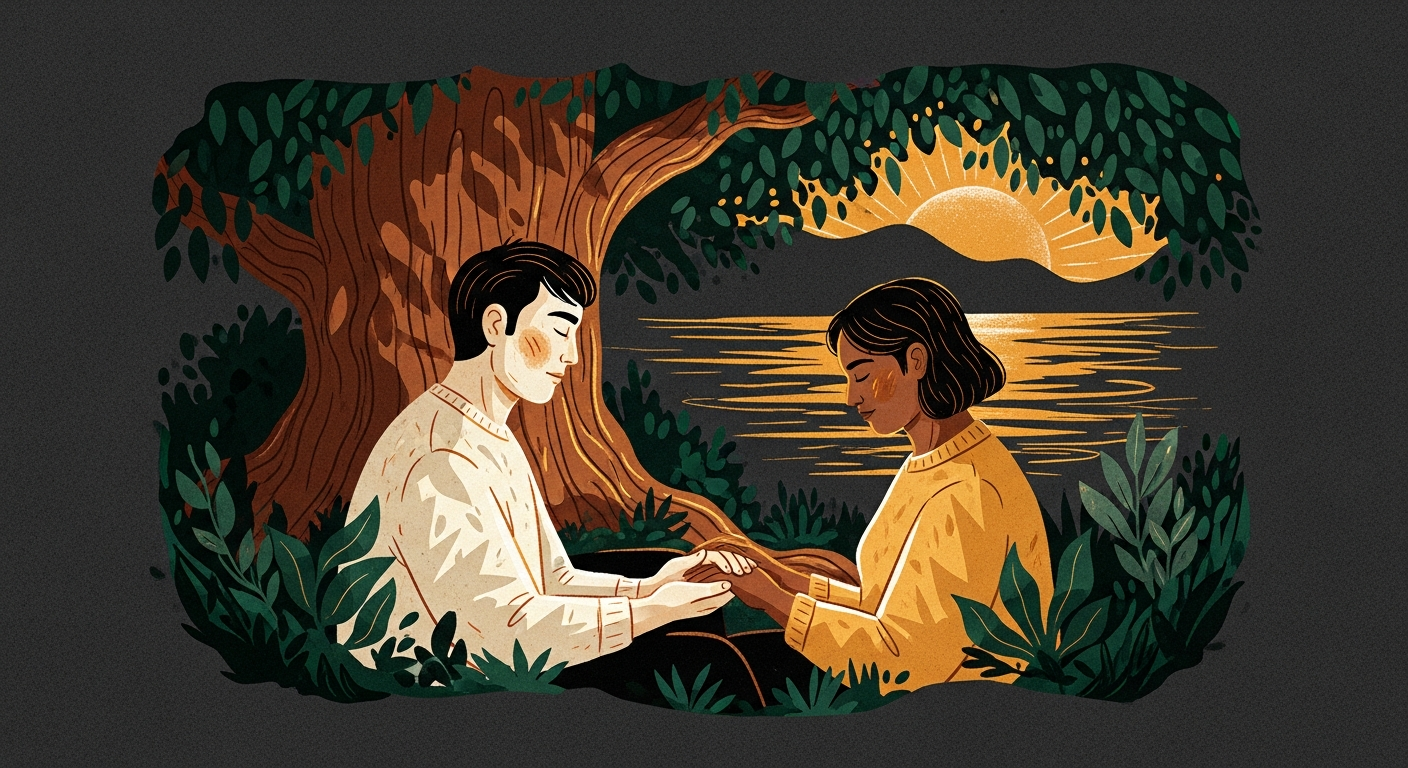
Self-care tips for partners of compulsive gamblers. Boundaries, financial protection, emotional recovery, and support resources — you deserve healing too.
"We showed up, we stayed up, we grew up" — Look At Us Now, 12&Well
Self-care for partners of compulsive gamblers is the intentional practice of protecting your emotional, physical, and financial well-being while navigating a loved one's addiction. It is not selfish — it is the foundation that makes everything else possible, including your own recovery and any support you offer your partner.
You didn't ask for this. You didn't sign up for the sleepless nights, the missing money, the lies that got so layered you stopped trusting your own memory. And somewhere along the way — between covering the bills and keeping the family afloat — you stopped taking care of yourself entirely.
That ends here.
If you're the partner of someone struggling with compulsive gambling, this guide is for you. Not for your partner. Not for the relationship. For you. Because you deserve your own recovery, your own peace, and your own path forward — whether your partner ever walks into the rooms or not.
Why Self-Care Isn't Selfish — It's Survival
There's a voice in your head that says focusing on yourself is abandoning your partner. That voice is wrong.
Research from the National Council on Problem Gambling (NCPG) estimates that for every person with a gambling problem, five to ten additional people are significantly affected — and intimate partners bear the heaviest burden (NCPG, 2023). A study published in the Journal of Gambling Studies found that partners of compulsive gamblers experience rates of depression, anxiety, and stress-related physical illness that rival those of the person gambling (Kalischuk et al., 2006). You're not imagining how bad it feels. Your body is keeping score.
Self-care isn't a luxury spa day hashtag. It's the baseline that keeps you from drowning alongside someone else.
In Gam-Anon — the fellowship for families and loved ones of compulsive gamblers — they have a saying: "You didn't cause it, you can't control it, and you can't cure it." Those three Cs aren't a platitude. They're a lifeline. And the moment you truly absorb them, self-care stops feeling selfish and starts feeling like the only sane response.
The Emotional Toll No One Talks About
Hypervigilance and Trust Destruction
You check bank statements. You monitor their phone. You lie awake listening for the sound of a car leaving the driveway. This state of constant surveillance is exhausting — and it rewires your nervous system over time.
According to the Substance Abuse and Mental Health Services Administration (SAMHSA), partners of people with addictions frequently develop symptoms consistent with post-traumatic stress, including hypervigilance, emotional numbness, and intrusive thoughts (SAMHSA, 2022). You're not "overreacting." Your brain has adapted to an environment of unpredictability.
The Shame Spiral
Maybe you haven't told anyone. Maybe you smile through family dinners while your savings account sits empty. The American Psychological Association notes that stigma around gambling addiction is significantly higher than for substance use disorders, which means supporters often carry their pain in silence (APA, 2021). That silence compounds the damage.
Codependency Patterns
You've probably become an expert at managing chaos. Covering bounced checks. Making excuses. Monitoring and controlling. These behaviors make total sense in the moment — but over time they can become their own kind of addiction. You get so focused on managing their crisis that you lose track of your own life entirely.
This is why Gam-Anon exists. This is why your recovery matters independently of theirs.
Building Your Self-Care Practice
Self-care for the partner of a compulsive gambler looks different from what most wellness content describes. You're not just stressed — you're living in a crisis that may be ongoing. Your self-care plan needs to account for that reality.
1. Get Honest With at Least One Person
Break the silence. Tell someone — a trusted friend, a therapist, a Gam-Anon group, an online community. The shame loses its power when you say it out loud.
If you're not ready for a meeting or a face-to-face conversation, 12&Well's community features offer peer matching specifically for supporters. Sometimes it's easier to be honest with someone who already knows what this feels like. You can also explore the Am I Enabling? assessment — it's free, private, and can help you see patterns you might be too close to recognize on your own.
2. Separate Your Finances — Now
This is not about punishment. It's about protection.
Open a bank account in your name only. Change passwords. Remove your partner's access to shared credit cards if needed. The NCPG reports that the average debt caused by compulsive gambling ranges from $40,000 to $70,000 per household (NCPG, 2023). You cannot afford to wait until "things get better" to protect yourself financially.
If you need help getting a clear picture of where things stand, the Financial Clarity tool lets you map out your income, debts, and creditor priorities in about ten minutes — no account required. That clarity can be the starting point for a plan, whether you're working with a financial counselor or figuring it out on your own.
3. Set Boundaries — and Keep Them
Boundaries are not ultimatums. They're decisions about what you will and won't accept.
A boundary sounds like: "I will not cover any more gambling debts." An ultimatum sounds like: "If you gamble again, I'm leaving." The difference matters. Boundaries are about your behavior, not theirs.
Here's what's hard — boundaries only work if you hold them. And holding them when someone you love is suffering feels brutal. This is where your own support system becomes essential. A Gam-Anon sponsor, a therapist, or a peer supporter can help you stay grounded when the pressure to cave feels overwhelming.
4. Reclaim Something That Is Yours
When did you last do something just because you wanted to? Not because it needed doing. Not because it would help your partner. Something for the simple, unremarkable joy of it.
Go for a walk. Pick up the book you put down six months ago. Call the friend you've been avoiding because you didn't want to explain. Recovery — yours — includes rediscovering who you are outside of this crisis.
The lyric that opens this piece — "We showed up, we stayed up, we grew up" — was written about the slow, unglamorous work of recovery. Showing up for yourself is part of that work. It counts. It matters.
5. Move Your Body
This sounds simple, and it is. Stress hormones accumulate in your body — cortisol, adrenaline, the whole fight-or-flight cascade. Movement metabolizes them. You don't need a gym membership. A twenty-minute walk changes your biochemistry.
Research published in Frontiers in Psychology found that moderate physical activity significantly reduced anxiety and depression symptoms in caregivers of people with addictions (Frontiers in Psychology, 2020). Your body has been absorbing the impact of someone else's addiction. Give it a way to process.
6. Consider Your Own Recovery Program
Gam-Anon meetings follow a 12-step framework specifically designed for the families and loved ones of compulsive gamblers. For many supporters, walking into their first meeting is the moment everything shifts — because for the first time, they're surrounded by people who get it.
But meetings aren't the only path. SMART Recovery offers a family and friends program based on cognitive behavioral techniques. Individual therapy — particularly with a counselor who specializes in addiction — can be transformative. And digital tools like Hope AI from 12&Well offer 24/7 support when the anxiety hits at 2 AM and you need to talk to something that won't judge you.
The point is: pick a path. Any path. The one that fits your life, your comfort level, your schedule. What matters is that you stop trying to white-knuckle this alone.
What About the Relationship?
You might be wondering where your partner fits in all of this. Here's the honest truth — their recovery is their responsibility. Yours is yours.
That doesn't mean you stop caring. It means you stop making their choices your emergency. It means you build a life that is stable whether they recover or not. And paradoxically, that stability often becomes the most powerful thing you can offer the relationship.
Some partners of compulsive gamblers stay. Some leave. Both are valid. What isn't sustainable is staying while abandoning yourself.
If your partner is in recovery — attending GA meetings, working with a sponsor, using tools like 12&Well's Browser Shield to block gambling sites — you can support that from a healthy distance. Encourage without managing. Love without controlling. And continue to show up for your own growth regardless of what they do.
When You Need More Than Self-Care
Self-care has limits. If you're experiencing any of the following, please reach out for professional help:
- Persistent depression or anxiety that interferes with daily functioning
- Thoughts of self-harm
- Financial crisis that feels unmanageable
- Domestic violence or emotional abuse connected to gambling behavior
Call the National Problem Gambling Helpline at 1-800-522-4700 — it's free, confidential, available 24/7, and it's not just for the person gambling. They have resources for family members too.
If you're in immediate danger, call 911.
You Are Allowed to Grow — Even if They Don't
Recovery isn't linear for anyone — not for the person gambling, and not for you. There will be setbacks. There will be days when the old patterns pull hard. But every time you choose yourself — every time you hold a boundary, show up to a meeting, use a tool, talk to someone who understands — you're building something real.
You showed up. You're staying up. You're growing.
That's not nothing. That's everything.
Frequently Asked Questions
How do I take care of myself when my partner is gambling?
Start by breaking the silence — tell at least one trusted person what you're going through. Separate your finances to protect yourself. Set clear boundaries about what you will and won't accept. Join a support group like Gam-Anon or connect with a peer supporter through platforms like 12&Well. Prioritize basic physical care — sleep, movement, nutrition. And remember that your well-being is not conditional on your partner's recovery. The National Problem Gambling Helpline (1-800-522-4700) has resources specifically for family members.
What is Gam-Anon and how is it different from GA?
Gam-Anon is a 12-step fellowship specifically for the spouses, partners, family members, and friends of compulsive gamblers. While Gamblers Anonymous (GA) serves the person in recovery, Gam-Anon focuses on your healing. Meetings provide a safe space to share experiences, learn from others in similar situations, and work through the 12 steps from the supporter's perspective. You can find meetings at gam-anon.org. If in-person meetings don't fit your life, online communities and digital support tools — like those offered through 12&Well — provide alternative pathways to connection.
Am I enabling my partner's gambling?
Enabling happens when your actions — however well-intentioned — make it easier for someone to continue gambling without facing the full consequences. Common examples include covering their debts, lying to family or employers on their behalf, or giving them money "one last time." The line between helping and enabling can be blurry, especially when you love someone. 12&Well's free Am I Enabling? assessment can help you identify patterns, and talking with a Gam-Anon sponsor or therapist provides deeper guidance on where your boundaries need to be.
Can a relationship survive gambling addiction?
Yes — but it requires recovery on both sides. The person gambling needs to address their compulsive behavior through GA, therapy, digital tools, or whatever path works for them. And the partner needs their own recovery work — healing from the emotional and financial damage, rebuilding trust in themselves, and learning new relational patterns. Many couples do rebuild, but it takes time, professional support, and a willingness from both people to do the hard work. Some relationships don't survive, and that is also a valid outcome. Your worth is not defined by whether the relationship continues.
This content is for informational purposes only and is not a substitute for professional medical advice, diagnosis, or treatment. If you or someone you know is struggling with compulsive gambling, call the National Problem Gambling Helpline at 1-800-522-4700 — available 24/7, free, and confidential.
12&Well Editorial Team — Written by people in recovery, for people in recovery. Our team includes GA members, Gam-Anon members, and recovery advocates. We never accept funding from the gambling industry. If you need help right now, call 1-800-522-4700 (24/7).
recovery doesn't happen alone.
Join the waitlist for 12&Well — 24/7 AI support, geo protection, recovery music, and tools for the whole family.
Join the Waitlist