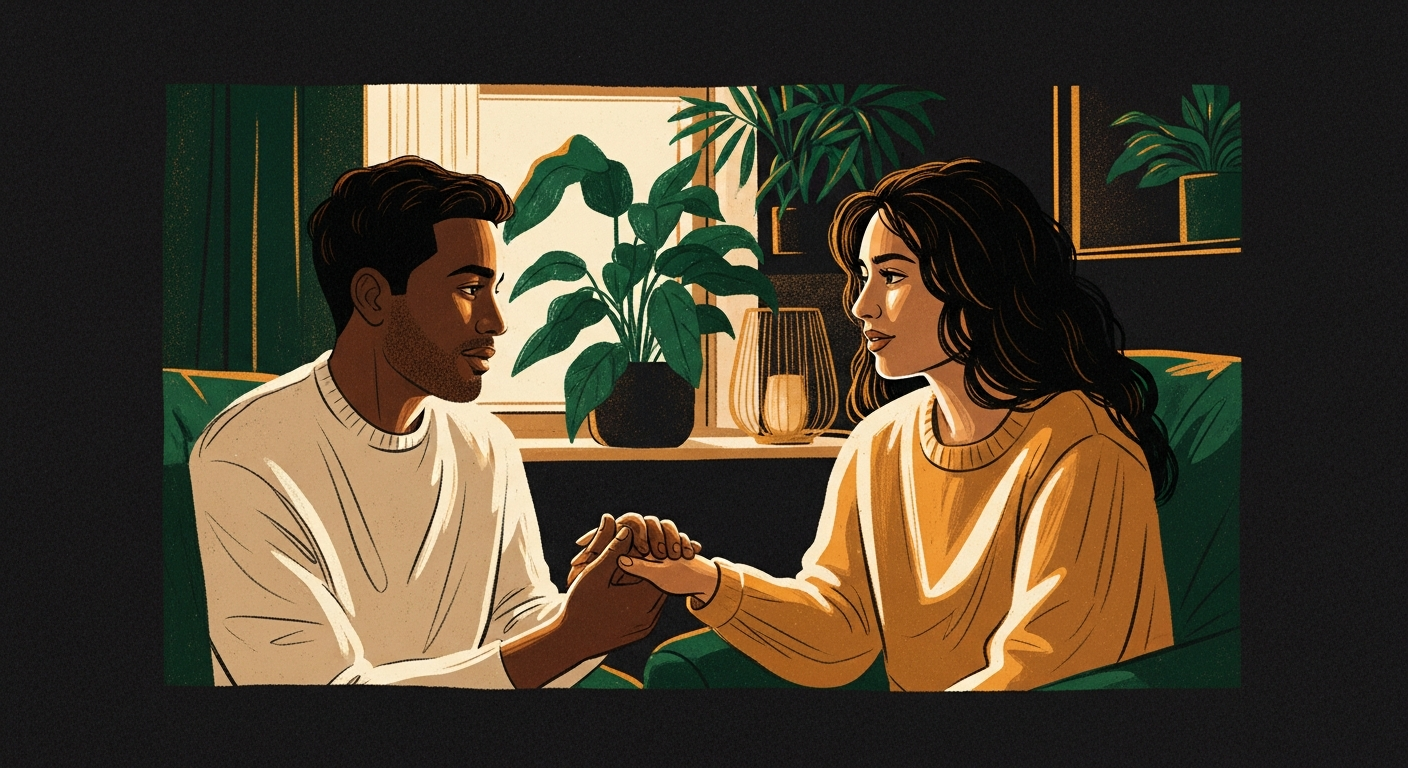
Learn how to talk to your partner about gambling addiction with compassion, boundaries, and practical steps. Free resources for supporters.
"Three hours where nobody needed a damn thing from me" — The Invisible Woman, 12&Well
Talking to a partner about their gambling means starting an honest, compassionate conversation about what you've noticed — without shame, blame, or ultimatums. It's one of the hardest things a supporter will ever do, and one of the most important. The goal isn't to fix them. It's to open a door they might not be able to open alone.
You've been rehearsing the conversation in your head for weeks. Maybe months. You've run through a dozen versions — the calm one, the angry one, the one where you lay out every bank statement and credit card bill like evidence in a courtroom. And then the moment comes and goes, and you say nothing. Again.
You're not weak for that. You're human.
If you're reading this, you already know something is wrong. The missing money. The late nights. The distraction that feels like a wall between you. The lies that started small and grew until you couldn't tell what was real anymore. According to the National Council on Problem Gambling, an estimated 5.6 million American adults meet the criteria for compulsive gambling — and for every one of them, there are six to ten people directly affected by their behavior (NCPG, 2023). You're one of those people. And your experience matters just as much.
This article is for you — the person standing on the other side of the door, trying to figure out how to knock.
Why This Conversation Feels So Impossible
Let's be honest about what you're up against. This isn't like telling your partner you wish they'd do the dishes more often. Gambling addiction — compulsive gambling — rewires the brain's reward system. The American Psychiatric Association recognizes it as a behavioral addiction with neurological patterns similar to substance use disorders (APA, DSM-5). Your partner isn't choosing to destroy your life together. Their brain is lying to them, telling them the next bet will fix everything.
That doesn't make your pain less real. It doesn't mean you should tolerate deception or financial harm. But understanding the "why" can help you walk into the conversation with something other than pure fury — even when the fury is completely justified.
There's also this: you might be afraid of what happens after you say it out loud. If you name it, it becomes real. If it becomes real, everything changes. That fear keeps a lot of supporters silent far longer than they want to be.
The lyric from "The Invisible Woman" captures something supporters know in their bones — that desperate need for three hours where nobody needs anything from you, where you can just exist without managing someone else's crisis. If that resonates, you're not alone. And that exhaustion is a sign it's time to speak up — not just for your partner, but for yourself.
Before You Say a Word — Prepare Yourself
The most important work happens before the conversation starts.
Get Clear on What You've Observed
Write down specific, factual observations — not accusations. "I noticed $2,000 missing from our savings account" lands differently than "You're gambling away our future." Facts are harder to deflect. They also help you stay grounded when the conversation gets emotional, because it will.
Check Your Expectations
Here's the hard truth: this conversation probably won't end with your partner saying, "You're right, I'll stop." Research from the Journal of Gambling Studies suggests that individuals with gambling problems typically take an average of seven to ten years from the onset of problematic behavior to first seeking help (Slutske, 2006). Your conversation may plant a seed that takes time to grow. That doesn't mean it wasn't worth having.
Build Your Own Support First
You don't have to do this alone. Gam-Anon — the fellowship for families and loved ones of people who gamble compulsively — exists specifically for people in your position. SMART Recovery also offers a Family & Friends program with practical tools. And if you're not ready for a room or a meeting, 12&Well's community features connect supporters with peers who've walked this road. Sometimes you just need someone who gets it.
Choose the Right Moment
Not during or right after gambling. Not when either of you is exhausted, drinking, or already in an argument. Find a time when you're both relatively calm and unlikely to be interrupted. Private space. No audience. No kids in the next room who might overhear.
How to Start the Conversation
There is no perfect script. But there are approaches that keep the door open instead of slamming it shut.
Lead With "I" Statements
"I've been scared about our finances." "I feel alone when you disappear for hours." "I've noticed changes that worry me."
This isn't about letting your partner off the hook. It's about keeping their defenses low enough that they can actually hear you. The moment the conversation becomes about what they are — a liar, irresponsible, selfish — the walls go up and nothing gets through.
Name What You See, Not What You Assume
"I've noticed we're behind on the mortgage for the second month in a row, and I need to understand what's happening with our money."
You don't have to use the word "gambling" right away if you think it will trigger an immediate shutdown. Sometimes asking an open question — "Can you help me understand what's going on?" — creates more space than a direct accusation. Other times, direct is the only way through. You know your partner. Trust your instinct.
Expect Denial — and Don't Let It Derail You
Denial isn't just a defense mechanism. For someone deep in compulsive gambling, it's survival. They may genuinely believe they can stop on their own, that they're about to "get even," or that the problem isn't as bad as you think. A study published in the Journal of Behavioral Addictions found that minimization and denial are among the most common cognitive distortions in people with gambling problems (Myrseth et al., 2010).
You don't need to win an argument. You just need to say what you came to say. "I love you, and I'm worried. I'm here when you're ready to talk about it." Then stop. Silence can do more than another hour of persuasion.
What Not to Do
Don't Issue Ultimatums You Won't Follow Through On
"If you don't stop gambling, I'm leaving" is only useful if you mean it and are prepared to act on it. Empty threats teach your partner that your words don't match your actions — which makes every future conversation less credible.
Don't Try to Control Their Gambling
Hiding their phone, monitoring every transaction, demanding they hand over their wallet — these tactics might feel like protection, but they often become a full-time job that leaves you more exhausted and resentful. They also don't address the root problem. You can't recover for someone else.
Don't Cover for Them
Paying off their debts without accountability, lying to family about where the money went, making excuses for their absences — this is enabling, even when it comes from love. 12&Well's free Am I Enabling? Assessment can help you honestly evaluate where you are on this spectrum. It takes a few minutes, it's private, and it might show you patterns you haven't been able to see on your own.
Don't Ignore Your Own Financial Safety
If your finances are intertwined, you have every right to protect yourself. Separate accounts, freezing joint credit cards, consulting with a financial advisor — these aren't betrayals. They're boundaries. 12&Well's Financial Clarity tool lets you see the full picture of income, debts, and priorities in about ten minutes — no account required. It's a practical step when everything feels chaotic.
After the Conversation — What Comes Next
The conversation doesn't end when someone leaves the room. In many ways, it's just the beginning.
If They're Open to Getting Help
Gently offer options — not demands. Some people respond to the fellowship of GA meetings. Others want therapy, either individual or couples. Some need a digital-first approach — a place to start when the rooms feel too intimidating. 12&Well's Hope AI is available 24/7 by text, voice, or SMS for exactly this reason — it's a first step that doesn't require walking into a room full of strangers.
Share the National Problem Gambling Helpline: 1-800-522-4700. It's free, confidential, and available 24/7. You can also text or chat. Sometimes handing someone a phone number is the bravest thing you can do.
If They're Not Ready
This is the outcome most supporters face the first time, and it hurts. But remember — you didn't fail. You opened a door. Research shows that supportive family involvement significantly improves the likelihood that someone with a gambling problem eventually seeks help (Kourgiantakis et al., 2013, Journal of Gambling Studies).
In the meantime, take care of yourself. Go to Gam-Anon. Use 12&Well's supporter community to connect with people who understand. Listen to music that speaks to what you're going through — the album The Rooms We Lived In Vol. 1: Where I Disappeared was written specifically for the experience of being the one who loves someone through this. It's not therapy, but sometimes a song that names your pain can make you feel less invisible.
Protect Yourself No Matter What
Regardless of what your partner decides, you get to have boundaries. You get to decide what you're willing to live with. You get to prioritize your own mental health, your financial security, and your future. Recovery isn't just for the person who gambles — it's for you too.
When the Conversation Becomes a Crisis
If at any point you discover the financial damage is severe, if there are threats of self-harm, or if you feel unsafe, this is no longer a conversation — it's an emergency.
- National Problem Gambling Helpline: 1-800-522-4700
- 988 Suicide & Crisis Lifeline: Call or text 988
- Crisis Text Line: Text HOME to 741741
You do not have to manage a crisis alone. Ever.
The Long View
Here's what nobody tells you when you're preparing for this conversation: it might take more than one talk. It might take five. It might take a separation or a financial catastrophe before your partner is willing to look honestly at what's happening. And some days you'll wonder whether saying anything made a difference at all.
It did.
Every honest word you speak chips away at the isolation that compulsive gambling depends on. Every boundary you hold teaches both of you that love and accountability can coexist. Every time you refuse to pretend everything's fine, you're choosing reality over the comfortable lie.
That's what recovery looks like from the supporter's side. It's quieter. It's less celebrated. But it matters just as much.
You didn't cause this. You can't cure it. But you can stop carrying it alone.
Frequently Asked Questions
How do I bring up gambling without making my partner defensive?
Lead with what you've observed — specific, factual changes in behavior or finances — rather than labels or accusations. Use "I" statements like "I've been worried about our finances" instead of "You have a gambling problem." Choose a calm, private moment and keep your tone concerned rather than confrontational. Expect some defensiveness regardless — it's a natural response — and don't feel pressured to resolve everything in one conversation.
Can I force someone to stop gambling?
No. Compulsive gambling is a behavioral addiction recognized by the American Psychiatric Association, and it can't be controlled through external pressure alone. You can set boundaries, share your concerns, offer resources like the National Problem Gambling Helpline (1-800-522-4700) or GA meetings, and protect your own financial security — but the decision to seek help ultimately belongs to your partner. Focus on what you can control: your own well-being and your own recovery as a supporter.
What is Gam-Anon and is it just for spouses?
Gam-Anon is a 12-step fellowship for anyone affected by another person's gambling — spouses, partners, parents, siblings, children, friends. It's not therapy and it's not about fixing the person who gambles. It's a space where you can share openly with people who understand what you're going through. Meetings are free, confidential, and available both in-person and online at gam-anon.org. Other options include SMART Recovery's Family & Friends program and 12&Well's online supporter community.
What are the warning signs that my partner is gambling compulsively?
Common signs include unexplained financial problems or missing money, secretive behavior around phones or computers, mood swings tied to wins and losses, borrowing money from friends or family, lying about whereabouts or activities, withdrawal from relationships and responsibilities, and an inability to stop despite promises to quit. If you're noticing a pattern, trust your instincts. The NCPG estimates that compulsive gambling affects over 2 million American adults, and millions more experience significant harm from less severe gambling behavior.
This content is for informational purposes only and is not a substitute for professional medical advice, diagnosis, or treatment. If you or someone you love is struggling with gambling, call the National Problem Gambling Helpline at 1-800-522-4700 — free, confidential, 24/7.
12&Well Editorial Team — Written by people in recovery, for people in recovery. Our team includes GA members, Gam-Anon members, and recovery advocates. We never accept funding from the gambling industry. If you need help right now, call 1-800-522-4700 (24/7).
recovery doesn't happen alone.
Join the waitlist for 12&Well — 24/7 AI support, geo protection, recovery music, and tools for the whole family.
Join the Waitlist