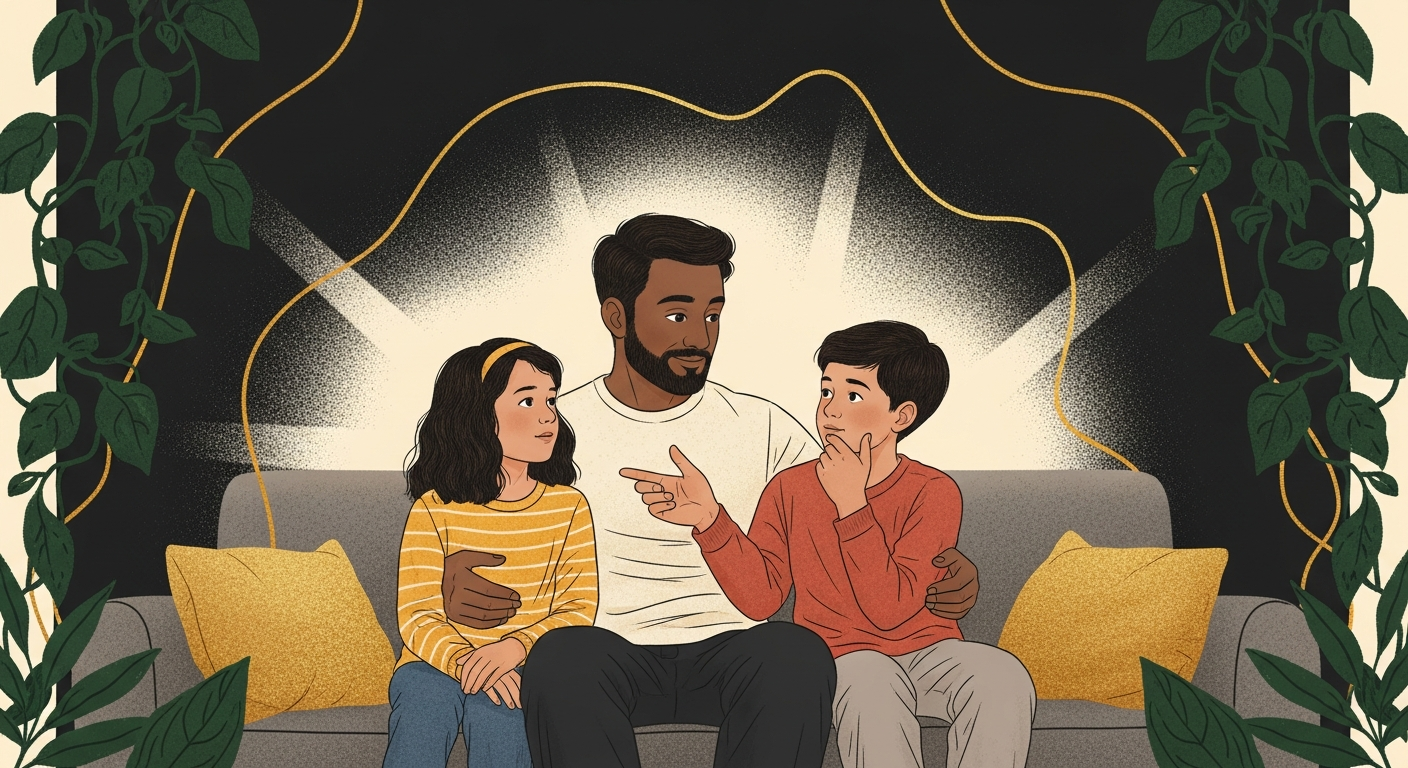
Learn how to talk to your kids about a parent's gambling problem with age-specific guidance, real strategies, and support resources for the whole family.
"I didn't know how to explain what I didn't understand myself." — from "Where I Disappeared," The Rooms We Lived In Vol. 1
Talking to your kids about a parent's gambling problem means having honest, age-appropriate conversations that name what's happening in the family without placing blame. It's about giving your children language for the confusion they already feel — because even when no one says a word, kids know something is wrong.
That might be the hardest sentence to sit with. But it's also the most important starting point.
You're here because you're thinking about your children. Maybe you're the spouse who discovered the debt. Maybe you're the one in recovery, trying to figure out how to face the people you love most. Maybe you're a grandparent or a family friend who sees what the kids are going through.
Whoever you are — you're already doing the right thing by asking how.
Why This Conversation Matters More Than You Think
Children in families affected by compulsive gambling experience significant emotional and behavioral effects — even when parents believe they've hidden the problem. Research from the National Council on Problem Gambling (NCPG) estimates that 6 to 10 million adults in the U.S. meet criteria for a gambling problem, and each one directly affects an average of 7 to 10 other people — with children among the most vulnerable (NCPG, 2023).
A study published in the International Gambling Studies journal found that children of people with gambling problems are more likely to experience anxiety, depression, feelings of abandonment, and difficulties in school (Darbyshire, Oster & Carrig, 2001). They often internalize the chaos around them, believing that the financial stress, the arguments, or the absent parent is somehow their fault.
Here's what we know from the rooms, from Gam-Anon meetings, from therapists, and from lived experience: silence doesn't protect your kids. It isolates them. The conversation you're afraid to have is the conversation that can begin to set them free.
Before You Say a Word — Prepare Yourself First
Get Grounded in Your Own Recovery
You can't pour from an empty cup, and you can't have a steady conversation with your kids if you're still in the middle of your own emotional storm. That doesn't mean you need to have everything figured out — it means you need some foundation beneath you.
If you're the parent in recovery, this might mean talking to your sponsor first, processing in a GA meeting, or working through what you want to say with a therapist. If you're the spouse or supporter, a Gam-Anon meeting or a session with a counselor who understands compulsive gambling can help you find your own footing.
Digital tools can help here too. 12&Well's Hope AI is available 24/7 — you can talk through what you're feeling, rehearse what you want to say, and process the fear before you sit down with your children. Sometimes you just need to say the words out loud to someone — even an AI companion — before you're ready to say them to a 9-year-old.
Agree on a Unified Message
If both parents are involved, get on the same page before bringing the kids in. This doesn't mean scripting every line — it means agreeing on a few key truths:
- What you will and won't share
- The tone you want to set (honest, calm, loving)
- Who will lead the conversation
- What words you'll use to describe what's happening
If the relationship between parents is strained — and in gambling-affected families, it often is — a family therapist can help mediate this step. The goal isn't to perform unity you don't feel. It's to make sure the kids aren't caught in the middle.
How to Talk to Kids at Every Age
There's no single script that works for every child. What a 5-year-old needs to hear is different from what a teenager needs. But certain principles hold across every age.
Young Children (Ages 4–7)
Young children don't need details. They need reassurance. At this age, kids are concrete thinkers — they understand feelings more than explanations.
Keep it simple:
- "Mommy/Daddy has been making some choices that have hurt our family. They're working on getting better."
- "Sometimes grown-ups have problems that make them act differently. It's not your fault."
- "We're going to be okay. There are people helping us."
Watch for behavioral changes — regression, clinginess, trouble sleeping, acting out. These are their words when they don't have words.
School-Age Children (Ages 8–12)
Kids in this range are perceptive. They've likely noticed the tension, the hushed phone calls, the arguments about money. They may have overheard more than you realize.
You can be more direct:
- "You know how some people have trouble with drinking or drugs? Some people have that same kind of trouble with gambling. It's something that takes over, and it's really hard to stop without help."
- "Dad/Mom is getting help right now. That might mean going to meetings, talking to someone, or using tools to stay on track."
- "You might feel angry, scared, or confused. All of those feelings are okay."
The American Psychological Association emphasizes that children in this age group benefit most from being given permission to feel — and from knowing that the adults around them are actively seeking help (APA, 2019).
Teenagers (Ages 13–18)
Teenagers often already know. They may have found the credit card statements, overheard a fight, or done their own research. What they need isn't information — it's honesty and respect.
Don't talk down to them. Don't minimize. And don't ask them to carry the family's emotional weight.
- "I want to be honest with you about what's been going on. [Parent] has been struggling with compulsive gambling, and it's affected our family in real ways."
- "I'm not telling you this to make you worry. I'm telling you because you deserve the truth, and because keeping secrets hasn't worked."
- "You don't have to fix this. This isn't your responsibility."
This is also the age where you should be aware of intergenerational risk. Research published in the Journal of Gambling Studies found that children of people with gambling problems are 2 to 4 times more likely to develop gambling issues themselves (Dowling et al., 2017). That doesn't mean it's inevitable — but it does mean honest conversation now can be genuinely protective.
With teens, you can also share what recovery looks like. Mention GA meetings, therapy, the tools your family is using. If they're curious, let them explore resources on their own — 12&Well's resource library and free tools are designed to meet people of all ages without judgment.
What to Say — and What Not to Say
Words That Help
- "This is not your fault."
- "You are allowed to feel however you feel about this."
- "We are getting help."
- "I love you, and that hasn't changed."
- "You can ask me questions whenever you want."
Words That Hurt — Even When You Don't Mean Them To
- "Don't tell anyone about this." (This teaches shame.)
- "If Dad/Mom really loved us, they'd stop." (Compulsive gambling doesn't work that way — and this plants seeds of resentment or hopelessness.)
- "We might lose the house." (Age-inappropriate financial burden. They don't need to carry this.)
- "You need to be strong for the family." (They're children. Let them be children.)
What to Do After the Conversation
Talking to your kids isn't a one-time event. It's the beginning of an ongoing, evolving dialogue. Here's what comes next.
Create Safety for Follow-Up Questions
Let your kids know the door stays open. Some children will ask questions immediately. Others will come to you days or weeks later, often at unexpected moments — in the car, at bedtime, in the middle of something else entirely. Be ready to pause and listen.
Watch, Don't Hover
Pay attention to changes in behavior, mood, school performance, and social interactions. The Substance Abuse and Mental Health Services Administration (SAMHSA) recommends that families affected by addiction — including gambling — consider family therapy as a way to address the whole system, not just the individual (SAMHSA, 2021).
Get Them Their Own Support
Just as you have your meetings and your tools, your kids may need their own space. Gam-Anon welcomes family members of all ages, and many communities have youth support groups. For older teens, organizations like SMART Recovery Family & Friends offer structured support.
12&Well's music catalog — especially tracks from The Rooms We Lived In — was written with families in mind. Sometimes a song says what a conversation can't. Listening together, or letting your teen listen on their own, can open doors that words alone don't reach.
Model Recovery Out Loud
The most powerful thing you can do for your children is let them see recovery in action. Let them see you go to meetings — or log in to your digital check-in. Let them see you use the tools. Let them see you have hard days and keep going.
According to the NCPG, children who witness a parent actively engaged in recovery show greater resilience and emotional adjustment than those in families where the problem is hidden or denied (NCPG, 2021).
You don't have to be perfect. You just have to be honest.
When You Need More Help
If your child is showing signs of significant distress — persistent anxiety, depression, self-harm, substance use, or academic decline — reach out to a licensed therapist who specializes in family systems or addiction-affected families. This isn't a failure. It's the next right step.
And if you or someone in your family is in crisis right now, call the National Problem Gambling Helpline at 1-800-522-4700. It's free, confidential, and available 24/7. They also support family members — it's not just for the person gambling.
12&Well offers a range of free tools that require no signup and no commitment. The Am I Enabling? Assessment can help you examine your own patterns. The Urge Surfing Tool supports the person in recovery with guided grounding exercises. And Hope AI is there at 2 a.m. when the fear hits and you don't know who to call.
You don't have to do this alone. And neither do your kids.
Frequently Asked Questions
How do I explain gambling addiction to a child?
Use language your child can understand based on their age. For younger children, compare it to something they know — "You know how it's hard to stop eating candy even when your tummy hurts? Gambling is like that for grown-ups, but much harder to stop." For older children, you can explain that compulsive gambling is a real condition where the brain gets stuck wanting to gamble even when it causes harm. Emphasize that it's not about being a bad person — it's about needing help. The NCPG and the American Psychiatric Association both classify gambling disorder as a recognized behavioral addiction (APA, DSM-5).
At what age should I talk to my kids about a parent's gambling?
There's no perfect age, but most family therapists recommend addressing it as soon as the child is showing signs of being affected — anxiety, behavioral changes, questions about money or why a parent is absent. Even children as young as 4 or 5 benefit from simple, reassuring explanations. Waiting until they're "old enough" often means they've been carrying confusion and fear alone for years.
How do I protect my kids from developing a gambling problem?
Open conversation is your most powerful tool. Research shows that children of people with gambling problems are 2 to 4 times more likely to develop gambling issues themselves (Dowling et al., 2017, Journal of Gambling Studies). Talking honestly about what happened in your family, modeling healthy coping skills, and staying aware of how normalized gambling is in youth culture — especially sports betting and online platforms — all reduce risk. Tools like 12&Well's Browser Shield can block access to gambling sites on family devices.
Should the parent with the gambling problem be part of the conversation?
When possible, yes — but only if they're in a stable enough place to participate without becoming defensive, minimizing, or making promises they can't keep. If they're actively working a recovery program — whether through GA, therapy, SMART Recovery, or a self-guided path — their presence can be powerful. It models accountability. But if the situation is volatile, it's okay for the non-gambling parent or a trusted family member to lead the conversation. A family therapist can help you decide what's right for your situation.
If you need support right now, call the National Problem Gambling Helpline at 1-800-522-4700 — free, confidential, 24/7. You can also text or chat. For family-specific support, visit Gam-Anon or explore 12&Well's free recovery tools.
This content is for informational purposes only and is not a substitute for professional medical advice, diagnosis, or treatment.
recovery doesn't happen alone.
Join the waitlist for 12&Well — 24/7 AI support, geo protection, recovery music, and tools for the whole family.
Join the Waitlist