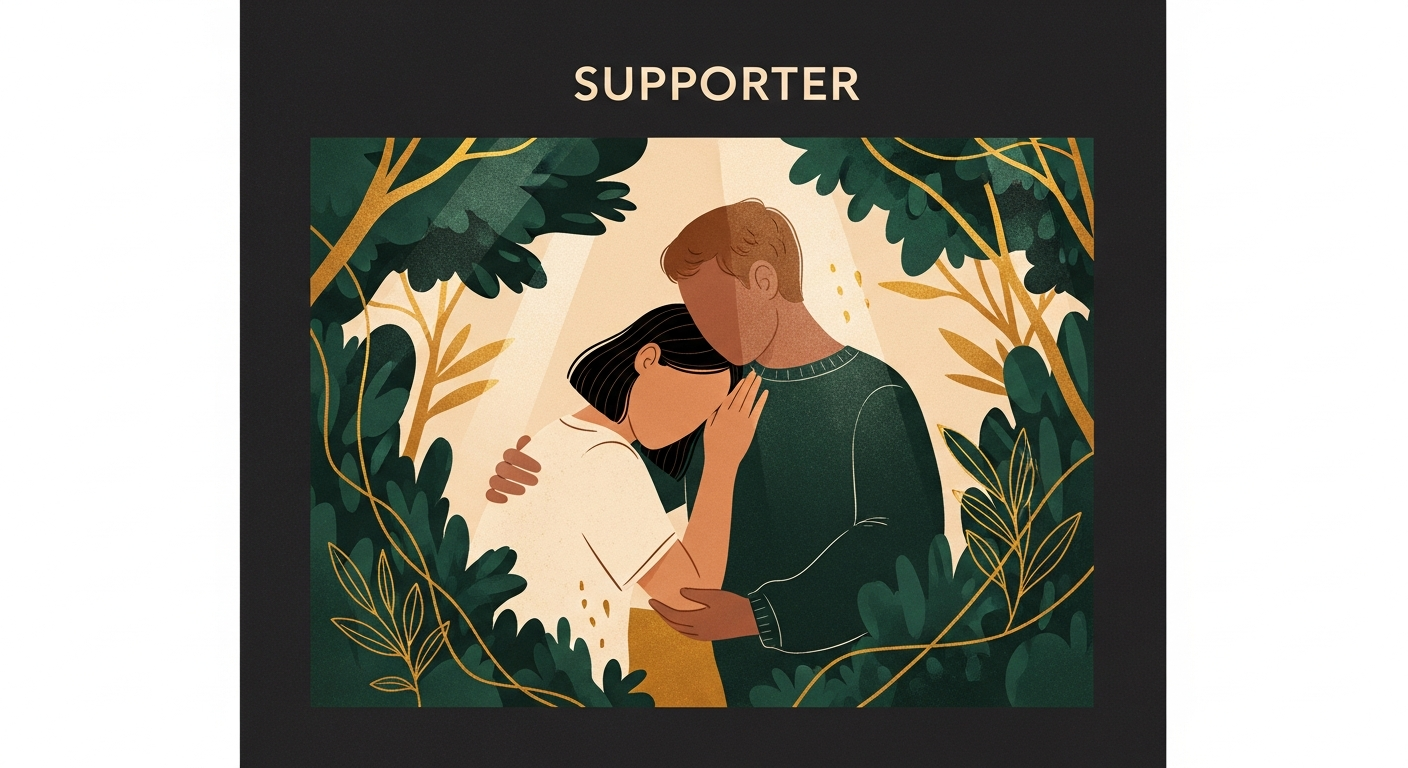
Learn how to help your spouse with a gambling addiction — set boundaries, protect finances, find support through Gam-Anon, and start healing.
Helping a spouse with a gambling addiction means learning to support their recovery without losing yourself in the process. It means setting boundaries, finding your own support system, getting honest about finances together, and understanding that compulsive gambling is a real addiction — not a choice, not a moral failing, and not something love alone can fix.
If you're reading this, you already know something is wrong. Maybe you found the bank statements. Maybe the lies stopped adding up. Maybe your spouse told you themselves — or maybe you just feel it in your gut, that quiet dread that something is pulling your partner away from you and your family.
You're not imagining it. And you're not alone.
An estimated 5.3 million adults in the United States meet the criteria for a gambling problem in any given year (National Council on Problem Gambling, 2023). Behind each of those numbers is a partner, a family, a household absorbing the fallout. Research shows that for every person struggling with compulsive gambling, an average of 8 to 10 additional people are directly affected — and spouses bear the heaviest weight (NCPG).
This guide is for you. Not just for helping your spouse, but for helping yourself find solid ground while everything feels like it's shifting underneath you.
Understand What You're Actually Dealing With
The first thing that helps — and it might also be the hardest — is accepting that compulsive gambling is an addiction, not a behavior problem.
Your spouse isn't gambling because they don't love you enough to stop. They're not gambling because they're selfish or weak or don't care about the bills. The American Psychiatric Association classifies gambling disorder in the same category as substance use disorders because it hijacks the brain's reward system in remarkably similar ways. Functional MRI studies show that the same dopamine pathways activated by drugs and alcohol light up during gambling — and over time, the brain requires more risk, more action, more of the rush just to feel normal (APA, DSM-5-TR).
This doesn't excuse the behavior. It doesn't erase the damage. But it reframes the conversation from "why won't you just stop?" to "what does recovery actually look like?"
Understanding this distinction matters because it changes how you respond. You stop trying to control the gambling and start focusing on what you can control — your boundaries, your finances, your own healing.
The Signs You Might Already Recognize
You probably don't need a checklist at this point — you've been living it. But it helps to name what you've been seeing:
- Unexplained financial gaps, missing money, or secret accounts
- Mood swings tied to no visible cause — elation followed by withdrawal
- Increasing secrecy around their phone, computer, or schedule
- Borrowing money from family or friends with vague explanations
- Defensiveness or anger when you ask questions about spending
- Promises to stop that don't hold
If this list feels like your daily life, trust what you already know.
Protect Yourself and Your Family First
This might feel counterintuitive. You searched "how to help my spouse," and here we are telling you to start with yourself. But there's a reason every flight attendant says to put on your own mask first.
Get Honest About the Finances
Financial devastation is the most common consequence of compulsive gambling in a marriage. A study published in the Journal of Gambling Studies found that partners of people with gambling problems report average household debts between $55,000 and $90,000 attributable to gambling (Kalischuk et al., 2006).
Here's what you can do right now:
- Pull your credit reports — all three bureaus. You need to know what's out there.
- Separate what you can — open an individual account if you don't have one. This isn't about punishment. It's about survival.
- Freeze joint credit lines if possible — or at minimum, set up alerts on all accounts.
- Use a financial clarity tool — 12&Well's Financial Clarity tool at /financial-clarity lets you map out income, debts, and creditor priorities in about 10 minutes. It's free, private, and doesn't require an account. Some people bring their results to a Gam-Anon meeting or a session with a financial counselor.
Financial honesty is one of the most painful parts of this process. But you can't build a recovery plan — for either of you — on a foundation you can't see.
Set Boundaries, Not Ultimatums
There's a difference between a boundary and an ultimatum, and it matters.
An ultimatum says: "If you gamble again, I'm leaving." A boundary says: "I will not co-sign any new loans. I will not cover debts I didn't agree to. I will attend my own support meetings regardless of what you decide to do."
Boundaries are about your behavior, not theirs. They're about what you will and won't participate in. And they hold whether your spouse enters recovery or not.
This is where the concept of enabling becomes important — and uncomfortable.
Ask Yourself the Hard Questions About Enabling
Enabling doesn't mean you caused the addiction. It means that some of the ways you've been coping — out of love, fear, or survival — might be making it easier for the gambling to continue.
Common enabling patterns for spouses include:
- Paying off gambling debts to avoid consequences
- Lying to family or friends to cover for your partner
- Taking over all financial responsibilities without accountability structures
- Minimizing the problem ("it's not that bad" or "at least it's not drugs")
- Avoiding the topic entirely to keep the peace
If any of that stings, you're not alone. Most supporters have been there. 12&Well offers a free Am I Enabling? Assessment — it's a private, scored self-check that takes a few minutes and gives you personalized results. No one sees your answers but you.
Support Their Recovery Without Owning It
Here's the truth that no one wants to hear: you cannot recover for your spouse. You can't want it enough for both of you. You can't do the work for them.
What you can do is create conditions where recovery becomes possible — and stop creating conditions where gambling feels consequence-free.
Learn About the Recovery Options
Recovery isn't one path. Your spouse might find their footing in the rooms of Gamblers Anonymous, where the 12-step framework has helped people find recovery for decades. They might work with a therapist trained in cognitive behavioral therapy for gambling. They might start with a digital tool like 12&Well's Hope AI — a 24/7 AI companion designed for gambling recovery that offers daily check-ins, urge support, and a structured 12-step journey.
Some people use all of these. Some start with one and build from there. The point is that recovery is available in more forms than ever before, and your spouse doesn't have to walk into a room full of strangers on day one if they're not ready — though many people find the rooms to be the thing that finally changes everything.
What matters is that something starts.
Have the Conversation
When you're ready to talk to your spouse about what you've been seeing, a few things help:
- Choose a calm moment — not during or right after a crisis
- Use "I" statements — "I've noticed our savings are gone" rather than "You spent everything"
- Name what you know without interrogating — you're not a detective. You're a partner who's hurting.
- Share resources, not lectures — "I found this helpline: 1-800-522-4700. I found this app called 12&Well. I want us to look at this together."
- Be prepared for denial — and know that denial doesn't mean they'll never get help. It means they're not there yet.
If your spouse isn't ready to seek help, that doesn't mean you have to wait. Your recovery from the impact of their gambling can begin right now, on your own terms.
Find Your Own Recovery
This part isn't optional. It might be the most important section on this page.
Gam-Anon Exists for You
Gam-Anon is the 12-step fellowship specifically for the families and loved ones of compulsive gamblers. It's not couples counseling. It's not about your spouse. It's a room full of people who understand exactly what you've been going through — the sleepless nights, the secret checking of bank accounts, the cycle of hope and heartbreak.
You can find meetings at gam-anon.org. Many are available online now, so you don't even need to leave your house.
Therapy Matters
Individual therapy — particularly with a counselor who understands addiction and its impact on families — can be transformative for spouses. Look for therapists trained in family systems therapy or those with specific experience in gambling-related harm.
SAMHSA's National Helpline (1-800-662-4357) can help you find local providers, and the National Problem Gambling Helpline (1-800-522-4700) offers referrals for both the person gambling and their family members.
Build a Support Network That Gets It
You need people who understand. Not people who say "just leave" or "why do you stay?" — but people who know that love and addiction can exist in the same house, and that the answer is rarely as simple as walking out the door.
12&Well's community features include peer matching for supporters — connecting you with someone who's been where you are. The platform was built for the whole family, not just the person in recovery. Because your healing matters just as much.
When Relapse Happens
Not if. When. At least in the early stages, relapse is common — studies suggest that 40 to 60 percent of people recovering from addiction experience at least one relapse (National Institute on Drug Abuse). This doesn't mean recovery has failed. It means recovery is a process, not an event.
Your job during a relapse is not to fix it. Your job is to hold your boundaries, care for yourself, and let the consequences of the relapse belong to the person who relapsed.
12&Well's Gambling Radar maps high-risk windows throughout the year — major sporting events, payday cycles, holiday stress periods — and offers 48-hour advance alerts via email, SMS, or browser push. It won't prevent a relapse, but it gives both of you a heads-up when the pressure is about to spike.
And the Browser Shield — a free Chrome extension that blocks over 264,000 gambling domains — is something you can install on shared household devices today. It takes two minutes and removes one more pathway to harm.
You Don't Have to Figure This Out Alone
The shame and isolation that surround gambling addiction don't just affect the person gambling. They wrap around the whole family. You might not have told anyone what's happening in your house. You might be holding this entirely by yourself.
You don't have to.
Call 1-800-522-4700. It's the National Problem Gambling Helpline, it's free, it's confidential, and it's available 24 hours a day, 7 days a week. They help family members too — not just the person gambling.
Download 12&Well and let Hope AI walk beside you — it's built for supporters as much as it's built for the person in recovery.
Find a Gam-Anon meeting this week.
You took the hardest step already. You went looking for answers. Now let someone help you carry this.
Frequently Asked Questions
How do I talk to my spouse about their gambling problem?
Choose a calm, private moment — not during a crisis or argument. Use "I" statements to describe what you've observed and how it's affecting you and your family. Share specific resources like the National Problem Gambling Helpline (1-800-522-4700) or tools like 12&Well rather than issuing demands. Be prepared for defensiveness or denial, and know that the first conversation rarely leads to immediate change — but it plants a seed.
Can a marriage survive a gambling addiction?
Yes. Many marriages not only survive gambling addiction but become stronger through the recovery process. Recovery requires honesty, accountability, and sustained effort from both partners — the person in recovery doing their work, and the supporter doing theirs. Couples who engage in both individual and shared support systems — whether through GA and Gam-Anon, therapy, or platforms like 12&Well — report higher rates of relationship recovery. But it takes time, and both people have to be willing to do the work.
What is enabling, and how do I stop doing it?
Enabling is any behavior — however well-intentioned — that shields the person gambling from the natural consequences of their addiction. Common examples include paying off gambling debts, lying to cover for them, or avoiding the subject to keep peace in the household. Stopping enabling starts with recognizing the patterns, setting clear personal boundaries, and getting your own support through Gam-Anon, therapy, or peer communities. 12&Well's free Am I Enabling? Assessment can help you identify specific patterns in your relationship.
Should I control my spouse's money to stop them from gambling?
Taking complete financial control can feel necessary in a crisis, but long-term, it often creates a parent-child dynamic that breeds resentment and doesn't address the underlying addiction. A healthier approach is collaborative financial transparency — agreed-upon structures like separate accounts for discretionary spending, shared visibility into all accounts, and tools like 12&Well's Financial Clarity to map out the full picture together. Many couples in recovery work with a financial counselor alongside their individual recovery programs.
This content is for informational purposes only and is not a substitute for professional medical advice, diagnosis, or treatment.
12&Well Editorial Team — Written by people in recovery, for people in recovery. Our team includes GA members, Gam-Anon members, and recovery advocates. We never accept funding from the gambling industry. If you need help right now, call 1-800-522-4700 (24/7).
recovery doesn't happen alone.
Join the waitlist for 12&Well — 24/7 AI support, geo protection, recovery music, and tools for the whole family.
Join the Waitlist