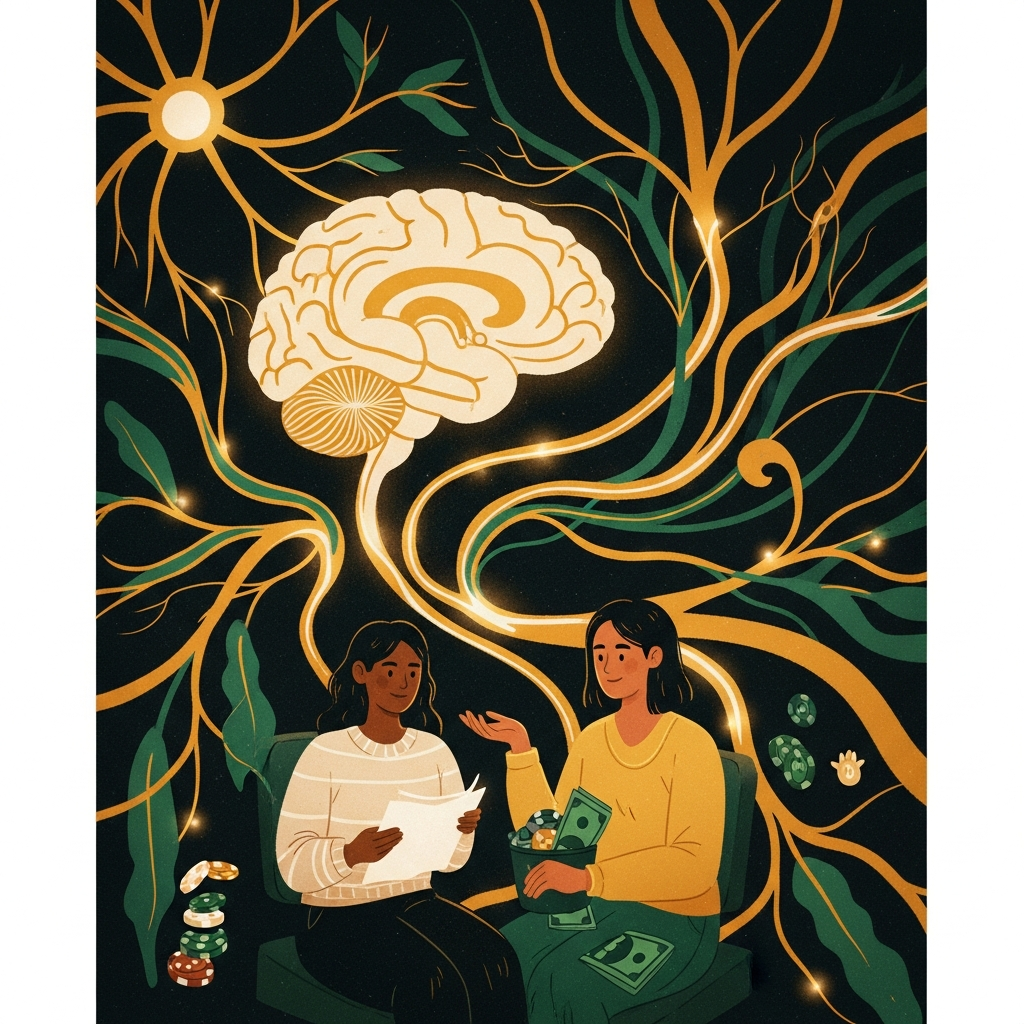
Gambling hijacks the brain's dopamine reward system, creating compulsive patterns that willpower alone cannot break. Understand the neuroscience behind gambling addiction.
Your brain on gambling
Every time you place a bet, your brain releases dopamine — the same neurotransmitter that floods your system during sex, eating, and other survival-essential behaviors. Dopamine is the brain's way of saying "do that again."
For casual gamblers, this produces a pleasant but manageable experience. For compulsive gamblers, the dopamine system has been fundamentally altered. Understanding how this happens is not an excuse — it's a roadmap to recovery.
The reward prediction error
One of the most important discoveries in addiction neuroscience is the concept of "reward prediction error," identified by Wolfram Schultz's research at Cambridge University.
Here's how it works:
- Expected reward, reward received — Normal dopamine levels. Your brain got what it predicted. No learning signal.
- Unexpected reward — Massive dopamine spike. Your brain says: "Remember exactly what you did to get this. Do it again."
- Expected reward, no reward — Dopamine drops below baseline. Your brain registers this as painful.
Gambling is uniquely powerful because of intermittent reinforcement — rewards are unpredictable. You don't win every time (that would become boring). You win just often enough to keep the prediction error firing. Slot machines, sports bets, and poker all exploit this mechanism.
Research from the University of Cambridge (published in Neuron, 2014) showed that compulsive gamblers have an exaggerated dopamine response to near-misses — outcomes that look like a win but aren't. Their brains treat "almost winning" the same as actually winning, creating a feedback loop that doesn't exist for non-gambling populations.
Tolerance: the escalating bet
Just like substance tolerance, gambling tolerance is real.
The initial thrill of a $20 bet fades over time. The brain downregulates its dopamine receptors — literally reducing the number of receivers available to detect the chemical. To achieve the same emotional response, you need a bigger bet.
A study in the American Journal of Psychiatry (2005) used PET scans to show that compulsive gamblers have significantly fewer D2 dopamine receptors compared to healthy controls. This biological change means:
- Everyday pleasures (food, conversation, nature) produce less satisfaction
- Gambling becomes one of the few activities that produces adequate stimulation
- The threshold for "enough" keeps rising
This is why telling a compulsive gambler to "just enjoy the small things" is neurologically tone-deaf. Their brains are physically less capable of deriving pleasure from normal activities — at least until recovery allows those receptors to begin restoring.
The prefrontal cortex problem
The prefrontal cortex (PFC) — the brain region responsible for impulse control, planning, and decision-making — is compromised in compulsive gamblers.
Functional MRI studies show reduced PFC activation in compulsive gamblers when faced with gambling cues. In practical terms, this means the brain's "braking system" is offline precisely when it's needed most.
When someone says "I knew I shouldn't gamble, but I couldn't stop myself," they are describing a neurological reality, not making an excuse. The knowledge that gambling is harmful resides in one part of the brain. The compulsion resides in another. And in addiction, the compulsion has a faster connection.
Stress and the cortisol connection
Stress is the most commonly reported trigger for gambling episodes. Here's why:
When you're stressed, your body produces cortisol (the stress hormone). Cortisol suppresses dopamine in the prefrontal cortex while simultaneously sensitizing the reward system. This creates a neurological double bind:
- Less impulse control (PFC suppressed by cortisol)
- Stronger craving (reward system sensitized)
- Gambling provides temporary relief (dopamine spike overrides stress)
This is why gambling often escalates during financial crises, relationship problems, work pressure, or other life stressors — the very consequences of gambling become triggers for more gambling.
What recovery does to the brain
The good news: the brain can heal.
Neuroplasticity research shows that the brain's dopamine system begins to normalize during sustained abstinence from gambling. The timeline varies by individual, but studies suggest:
- 2-4 weeks: Acute withdrawal symptoms (irritability, insomnia, cravings) begin to stabilize
- 3-6 months: Dopamine receptor density begins to increase, improving the ability to enjoy non-gambling activities
- 1-2 years: Significant PFC recovery, leading to improved impulse control and decision-making
- Ongoing: Continued improvement, though some degree of sensitization to gambling cues may persist indefinitely
Recovery programs like Gamblers Anonymous support this neurological healing by:
- Providing dopamine through healthy human connection (fellowship)
- Creating new neural pathways through step work and behavioral change
- Offering structured accountability that substitutes for the compromised PFC
- Reducing stress through community support and shared experience
Why willpower fails
Knowing all of this, it becomes clear why willpower alone is an inadequate strategy for gambling addiction.
Willpower is a function of the prefrontal cortex — the very region that has been compromised by addiction. Asking someone with gambling addiction to "just use willpower" is like asking someone with a broken leg to "just walk it off." The tool you're asking them to use is the tool that's broken.
Recovery requires support systems, environmental changes, new neural pathways, and — as the 12 steps describe — a power greater than oneself. Not because individual effort doesn't matter, but because individual effort alone is not enough when the brain's own circuitry has been rewired.
Frequently asked questions
Is gambling addiction genetic?
Studies of identical twins suggest that genetic factors account for 50-60% of the risk for developing gambling problems. Variations in dopamine receptor genes (DRD2, DRD4) and serotonin transporter genes have been identified as risk factors. However, genetics create vulnerability, not destiny.
Does online gambling affect the brain differently?
Research suggests that online gambling may create faster addiction patterns due to: instant access (no travel required), rapid play speed, ability to gamble in isolation, and the illusion of control through digital interfaces. The dopamine mechanisms are identical, but the delivery is more efficient.
Can medication help with gambling addiction?
Several medications have shown promise in clinical trials, including naltrexone (an opioid antagonist) and N-acetyl cysteine (an amino acid that modulates glutamate). However, medication alone is not considered sufficient — it works best in combination with behavioral therapy and support programs like GA.
recovery doesn't happen alone.
Join the waitlist for 12&Well — 24/7 AI support, geo protection, recovery music, and tools for the whole family.
Join the Waitlist