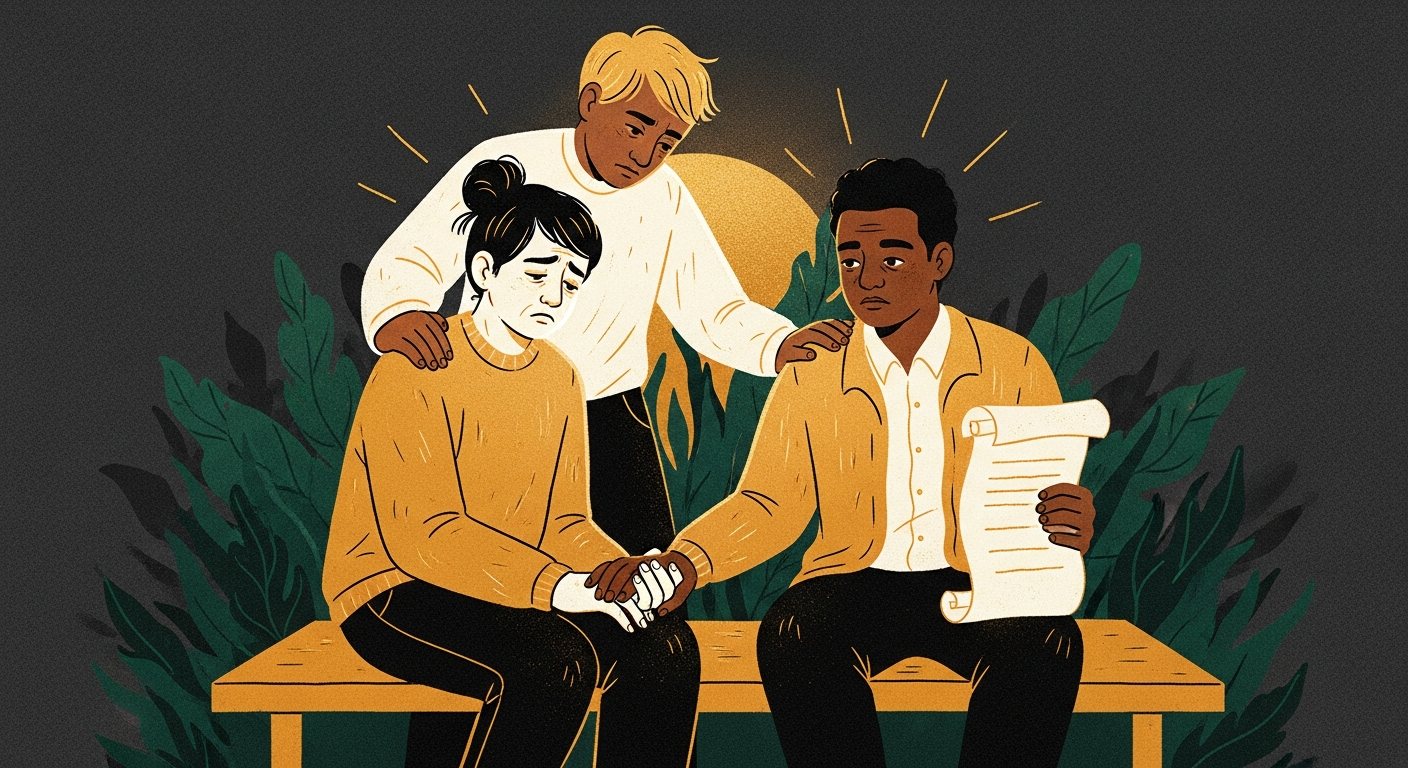
A step-by-step plan for tackling gambling debt in recovery — from getting honest about what you owe to rebuilding your financial future.
"I'm not the one who never stumbles — but the one who makes it through" — Good Mother, 12&Well
Gambling debt is money owed as a direct result of compulsive gambling — credit cards maxed out, loans taken to chase losses, bills left unpaid, savings drained. Recovery from gambling debt starts not with a payment plan but with stopping the gambling itself, then building an honest financial picture and a step-by-step path forward.
If you're reading this, you already know the weight. The letters you haven't opened. The calls you've been dodging. The running total in your head that you've stopped calculating because the number got too painful.
Here's what you need to hear: the debt is real, but it's not the whole story. The shame attached to it — that's the part that keeps people stuck. And you don't have to stay stuck.
This guide walks you through a practical, step-by-step plan for facing gambling debt in recovery. Not theory. Not judgment. Just a path forward.
How Big Is the Problem — and Why It Matters
You're not alone in this, even though it feels that way. Research from the National Council on Problem Gambling estimates that people who struggle with compulsive gambling carry an average of $55,000 in debt (NCPG, 2021). A study published in the Journal of Gambling Studies found that 80% of people seeking help for gambling had significant debt as a primary consequence (Blaszczynski & Nower, 2002). And according to SAMHSA, financial crisis is the number one reason people finally seek help for gambling — more than relationship problems, more than mental health (SAMHSA, 2023).
That last statistic is important. It means the debt that feels like your greatest failure might actually become the doorway to your recovery. Many people in the rooms will tell you the same thing — the financial wreckage was what finally made them willing to do something different.
Step 1: Stop the Bleeding
Before you can deal with what you owe, you have to stop adding to it. That means putting real barriers between you and gambling — not relying on willpower alone, because willpower isn't the issue here. Your brain's dopamine system has been hijacked, and it needs structural support, not just good intentions.
Practical Barriers That Work
- Hand over financial control. Give a trusted person — your spouse, a family member, your sponsor — access to your accounts. Remove your name from joint credit cards if needed. This isn't punishment. It's protection.
- Self-exclude. Every state has a self-exclusion program for casinos. Most online platforms have self-exclusion options too. Use them all.
- Block digital access. Install the 12&Well Browser Shield — it's a free Chrome extension that blocks over 264,000 gambling domains. It takes thirty seconds to install and it works quietly in the background.
- Delete apps and accounts. Every betting app, every online casino account. Delete them tonight.
This step isn't about the debt yet. It's about making sure the debt stops growing. You can't bail out a boat while the hole is still open.
Step 2: Get Honest About What You Owe
This is the part most people dread — and the part that brings the most relief once it's done. You need a complete, honest picture of your financial situation. Not a rough guess. Not the number you tell yourself when you're feeling optimistic. The real number.
How to Build Your Debt Picture
Gather everything: credit card statements, loan documents, overdue bills, money owed to family or friends, legal judgments, back taxes. Write it all down in one place.
If the idea of sitting down with a spreadsheet makes your chest tight, try 12&Well's Financial Clarity tool. It lets you connect your bank through Plaid or enter numbers manually and gives you a clear overview of income, debts, and creditor priorities in about ten minutes. No account needed. No one sees it but you. Some people bring the summary to their first meeting with a sponsor or a financial counselor — it gives you something concrete to work from instead of the vague dread.
In the rooms, this step connects directly to the principle behind Step 4 — taking a fearless moral inventory. Except here, it's a fearless financial inventory. And just like Step 4, the fear is almost always worse than the truth.
Step 3: Prioritize What Gets Paid First
Not all debt is equal. When money is limited — and in early recovery, it usually is — you need to triage.
Priority Order
- Essentials first. Rent or mortgage, utilities, food, transportation to work. Keep the lights on.
- Secured debts. Car loans, anything where you could lose an asset.
- Legal obligations. Court-ordered payments, child support, tax debt. These carry serious consequences if ignored.
- Unsecured debts. Credit cards, personal loans, medical bills. These matter, but they won't put you on the street tomorrow.
- Informal debts. Money owed to family and friends. These carry emotional weight, but financially they're often the most flexible.
A financial counselor can help you build this priority list. The National Foundation for Credit Counseling (NFCC) offers free or low-cost sessions, and many counselors have specific experience with gambling-related debt.
Step 4: Contact Your Creditors
This is where the avoidance instinct screams at you to close this page and do it later. Don't listen.
Creditors — especially credit card companies and medical providers — often have hardship programs you don't know about. Reduced interest rates. Payment pauses. Settlements for less than the full balance. But they can't offer what you don't ask for.
What to Say
You don't have to share your life story. A simple script works:
"I'm experiencing financial hardship and I'm working with a counselor to address my debts. I'd like to discuss hardship options — reduced payments, lower interest, or a payment plan I can sustain."
That's it. You'll be surprised how many doors open when you make the call.
If phone calls feel impossible right now, write the letters. Email. Use a credit counseling agency as an intermediary. The method matters less than the action.
Step 5: Build a Recovery-First Budget
A budget in recovery looks different from a normal budget. It has to account for the fact that your relationship with money has been weaponized by addiction — and that rebuilding that relationship takes intention.
Key Principles
- Automate everything you can. Bills on autopay. Savings pulled automatically on payday. The fewer financial decisions you have to make each day, the less mental energy gets spent near triggers.
- Build in recovery costs. Gas to get to meetings. A coffee after. The book. Whatever keeps you connected to your recovery — that's not optional spending, that's essential.
- Cash-based spending for discretionary money. Some people in recovery use the envelope method — a set amount of cash each week for food, personal expenses. When it's gone, it's gone. This creates a physical boundary that debit cards don't.
- No investment apps or crypto platforms. Not now. For many people who've struggled with compulsive gambling, these carry the same dopamine triggers. This is a boundary, not a limitation.
The 12&Well Financial Impact Calculator can help you see — in real numbers — how much you'll save over three months, six months, a year without gambling. Sometimes seeing the forward trajectory is the motivation you need to stick with the plan.
Step 6: Get Support That Fits Your Life
Debt recovery after gambling isn't a solo project. The shame tells you to hide. Recovery asks you to reach out.
Recovery Pathways for Financial Healing
- Gamblers Anonymous. The rooms are full of people who've faced the same financial wreckage. Working the steps — especially Steps 4 through 9 — directly addresses the financial harm and the amends process. Find a meeting at gamblersanonymous.org.
- Gam-Anon. If your gambling debt has affected your family, they deserve support too. Gam-Anon is specifically for the people who love someone with a gambling problem. The financial stress on a partner or parent can be just as crushing.
- Financial counseling. Look for a certified counselor through the NFCC who understands addiction-related debt. They can negotiate with creditors, help you build a debt management plan, and give you professional guidance without judgment.
- Therapy. Cognitive behavioral therapy has strong evidence for addressing the thought patterns that fuel compulsive gambling — including the financial distortions (APA, 2021). Many therapists now specialize in gambling-specific recovery.
- Digital tools and AI support. If you're not ready for a meeting — or you need support at 2 a.m. when no meeting is open — 12&Well's Hope AI is available 24/7. It remembers your story, checks in daily, and can walk you through urge moments or help you process the financial stress that hits between the structured support. It's not a replacement for human connection, but it fills the gaps when the gaps feel enormous.
That line from Good Mother — about being the one who makes it through, not the one who never stumbles — that's the posture of financial recovery too. You're going to have setbacks. A bill you forgot. A creditor who says no. A month where the budget doesn't work. Making it through isn't about perfection. It's about staying in the process.
Step 7: Protect Your Future
As the debt comes down — and it will, slowly — start building guardrails that protect the progress you've made.
- Freeze your credit if you're tempted to open new lines. All three bureaus offer free credit freezes.
- Set up the Gambling Radar alerts. High-risk windows — big sporting events, payday cycles, holidays — can trigger relapse. Getting a 48-hour heads-up before those windows arrive lets you plan instead of react.
- Check in with your sponsor or support person regularly about money. Financial secrecy is where relapse breeds. Keeping the conversation open — even when it's uncomfortable — is one of the strongest protections you have.
- Celebrate clean time milestones. Track them with the Recovery Day Counter. Every day without gambling is a day your debt isn't growing. That matters more than you realize.
A Note for Supporters
If you're the spouse, partner, or parent of someone dealing with gambling debt — your financial life has been affected too. Maybe devastated. You deserve your own support, your own recovery, and your own financial plan.
Gam-Anon meetings are a space built specifically for you. The Am I Enabling? Assessment can help you understand whether the support you're giving is helping recovery or unintentionally fueling the cycle. And a financial counselor who understands your situation can help you protect yourself and your family — including exploring whether separate accounts, legal protections, or formal agreements are appropriate.
Your healing matters. Not just as a function of your loved one's recovery — but as its own thing.
The Debt Doesn't Define You
Here's the truth that's hard to hold when you're staring at a pile of bills: the debt is a consequence, not a sentence. It's the damage left behind by a storm — and you are not the storm.
People rebuild after this. Every day, in meetings around the world and in quiet moments of private courage, people open the envelopes, make the calls, set up the payment plans, and start climbing out. It takes time. It takes help. And it takes the kind of willingness that brought you to this page.
If you need to talk to someone right now, call the National Problem Gambling Helpline at 1-800-522-4700. It's free, confidential, and available 24/7.
You don't have to figure this out tonight. But you do have to start. And reading this — that counts as starting.
Frequently Asked Questions
How do I pay off gambling debt with no money?
Start by contacting a nonprofit credit counseling agency through the National Foundation for Credit Counseling. They can negotiate reduced payments, lower interest rates, and debt management plans on your behalf — often at no cost to you. Simultaneously, cut off all gambling-related spending by self-excluding and blocking access. Even small, consistent payments build momentum and demonstrate good faith to creditors. The most important step is stopping the gambling so no new debt accumulates.
Can gambling debt be included in bankruptcy?
Yes. Gambling debt — including credit card balances, personal loans, and other unsecured debt accumulated through gambling — can generally be discharged in Chapter 7 bankruptcy or restructured in Chapter 13. However, bankruptcy carries significant long-term consequences for your credit and should be considered only after exploring other options. Consult a bankruptcy attorney and a financial counselor before making this decision. Courts may also scrutinize debts incurred very recently before filing.
How do I tell my spouse about gambling debt?
This conversation is one of the hardest parts of recovery — and one of the most important. If you're in GA, your sponsor can help you prepare. A couples therapist who understands addiction can also facilitate the conversation. Be honest about the full amount. Partial honesty often causes more damage than the original secret. Your spouse may also benefit from attending Gam-Anon. Tools like 12&Well's Financial Clarity overview can help make the conversation concrete rather than abstract — showing real numbers in a clear format rather than trying to explain it all from memory.
Does gambling debt affect your credit score?
Gambling itself doesn't appear on your credit report. But the financial behaviors it drives — maxed-out credit cards, missed payments, defaults, collections, and high credit utilization — all directly damage your credit score. Rebuilding credit after gambling follows the same principles as any credit repair: consistent on-time payments, reducing balances, avoiding new debt, and monitoring your reports for errors. Many people in recovery see meaningful credit score improvement within 12 to 24 months of consistent financial management.
This content is for informational purposes only and is not a substitute for professional medical advice, diagnosis, or treatment.
12&Well Editorial Team — Written by people in recovery, for people in recovery. Our team includes GA members, Gam-Anon members, and recovery advocates. We never accept funding from the gambling industry. If you need help right now, call 1-800-522-4700 (24/7).
recovery doesn't happen alone.
Join the waitlist for 12&Well — 24/7 AI support, geo protection, recovery music, and tools for the whole family.
Join the Waitlist